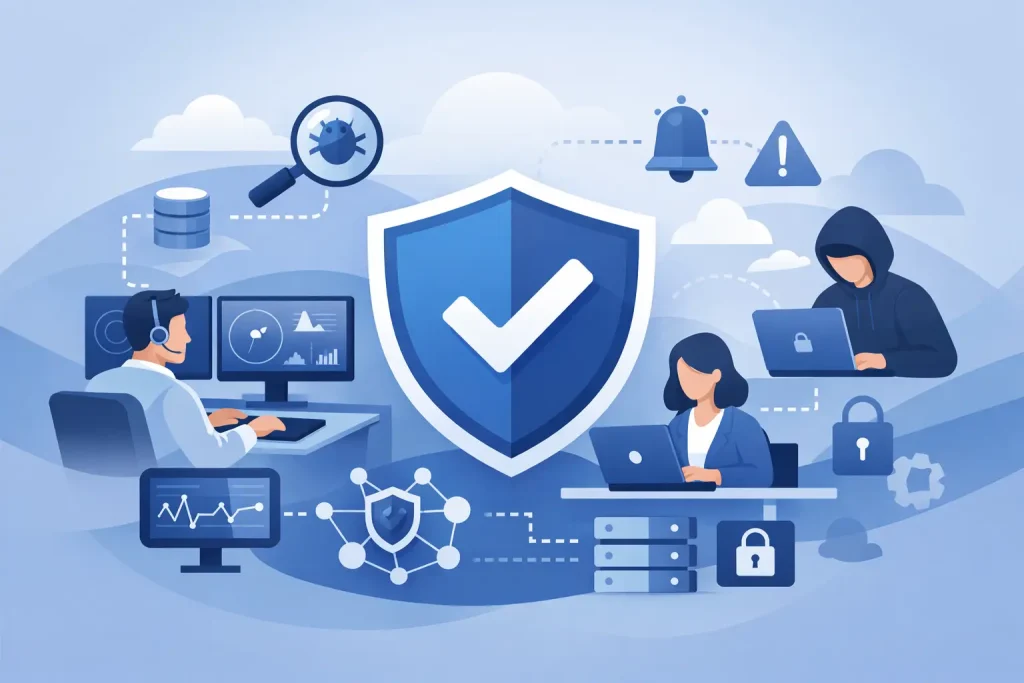

A suspicious login at 2:13 a.m. is not automatically a security incident. It could be a traveling employee, a failed application process, or an attacker testing stolen credentials. The question is whether anyone has the tools, context, and authority to determine the difference before business operations are affected. That is the practical answer to what is managed detection response: a security service that continuously identifies, investigates, and helps contain credible threats.
Managed detection and response, commonly called MDR, combines security technology with experienced analysts who monitor alerts around the clock. Rather than handing an internal team a stream of warnings to sort through, an MDR provider validates activity, connects related events, escalates real risk, and takes or guides response actions based on an agreed process.
For organizations that run healthcare facilities, retail locations, senior living communities, financial services offices, schools, or multi-site properties, MDR is less about adding another security dashboard. It is about reducing the time an attacker can operate inside the environment while maintaining clear accountability when a security event intersects with day-to-day operations.
What Is Managed Detection Response Designed to Solve?
Most businesses already have some security controls in place. They may use endpoint protection, firewalls, email filtering, multifactor authentication, and cloud security settings. Those controls generate valuable data, but they also generate noise. A small IT team can be overwhelmed by alerts, especially after hours or while supporting users, connectivity, VoIP, projects, and multiple locations.
MDR addresses the gap between having security tools and operating an active detection function. The service gathers telemetry from selected parts of the environment, such as endpoints, identity systems, email platforms, firewalls, and cloud services. Detection technology identifies unusual or known malicious behavior. Security analysts then investigate whether that behavior represents a real threat and determine the appropriate next action.
The distinction matters. A tool may flag a PowerShell command, a new administrator account, or an unusual data transfer. Each could be legitimate in the right context. MDR teams use threat intelligence, historical activity, device details, user behavior, and investigation methods to separate routine activity from incidents that require attention.
How MDR Works in Practice
A mature MDR service follows an operational cycle, not a one-time deployment. It begins with onboarding and continues through monitoring, response, tuning, and reporting.
1. Visibility is established
The provider deploys or connects approved security sensors and data sources. Endpoint telemetry is usually central because it provides visibility into what is occurring on workstations and servers. Depending on the environment, the service may also collect identity, firewall, cloud, email, and network information.
Coverage matters more than a long list of tools. An MDR program cannot detect what it cannot see. Unmanaged devices, remote systems without agents, neglected servers, and disconnected locations can create blind spots that need to be identified early.
2. Alerts are investigated, not just forwarded
Detection platforms correlate events and identify patterns associated with malware, credential theft, lateral movement, ransomware activity, unauthorized persistence, and data exfiltration. Analysts review the evidence behind those alerts. They determine whether activity is benign, suspicious, or confirmed malicious.
This investigation layer is where MDR earns its value. A raw alert says something may be wrong. A validated incident should explain what happened, which systems and users are involved, the likely scope, the level of urgency, and what should occur next.
3. Threats are contained under an agreed response model
Response can range from notifying the designated customer contact to actively isolating an endpoint from the network. For example, if a workstation shows signs of ransomware execution, rapid device isolation may prevent the threat from reaching shared systems. If an account appears compromised, the response may include disabling the account, forcing a password reset, revoking sessions, or requiring internal approval before action.
The right model depends on business risk and operating constraints. A 24/7 emergency department, property access system, or production environment may require different containment rules than a standard office laptop fleet. The provider should understand which systems are critical and who has authority to make time-sensitive decisions.
4. Findings improve the environment
An incident should produce more than an alert closure. Good MDR reporting identifies affected assets, attack methods, containment actions, and recommended follow-up. That may include patching a vulnerable system, tightening identity controls, removing unused accounts, adjusting firewall rules, improving backups, or training users on a recurring phishing technique.
Over time, this feedback helps organizations improve their security posture while focusing internal resources on decisions and remediation rather than constant alert review.
MDR Is Not the Same as Antivirus, SIEM, or an MSSP
The cybersecurity market uses overlapping terms, and the differences affect both cost and outcomes.
Traditional antivirus or endpoint protection is a product category. It prevents and detects many common threats on individual devices, but it does not necessarily include human investigation or incident response. Endpoint detection and response, or EDR, adds deeper device telemetry and detection capabilities. MDR often uses EDR as one source of data, then adds managed monitoring and analyst-led response.
A security information and event management platform, or SIEM, centralizes logs from many systems. It can be useful for compliance, investigation, and broad visibility, but a SIEM is not automatically a 24/7 security operations function. It requires thoughtful configuration, data management, detection engineering, and skilled people to interpret alerts.
Managed security service providers, or MSSPs, can offer a broad set of outsourced security services, including firewall management, vulnerability scanning, and log monitoring. Some provide MDR capabilities, but not every MSSP offering includes deep endpoint investigation, threat hunting, or hands-on containment. Buyers should ask exactly who investigates alerts, what response actions are included, and whether coverage is truly continuous.
What to Expect From an MDR Provider
MDR should create operational clarity, not another vendor queue. Before selecting a provider, organizations should understand the service boundaries and escalation process.
Ask whether analysts monitor the environment 24/7, including holidays and weekends. Confirm which data sources are covered and which critical systems remain outside the service. Review how incidents are prioritized, how quickly the provider contacts your team, and whether the provider can isolate devices or disable accounts when authorized.
It is also worth examining how the service fits the broader technology environment. A security alert may expose a weak VPN configuration, a failed circuit failover, an unpatched server, or an access-control issue that requires coordination across IT, networking, cloud, and communications systems. Fragmented ownership slows remediation. Organizations with distributed sites benefit when one team can coordinate the technical response across the stack rather than sending staff into a 1-800 black hole of separate vendors.
Reporting should be useful to both technical and business stakeholders. IT leaders need incident details, trends, and remediation guidance. Executives and finance leaders need a clear view of material risk, service performance, and where additional investment is justified. The goal is not a monthly report full of alert counts. It is evidence that risks are being identified, handled, and reduced.
The Trade-Offs to Consider
MDR does not replace foundational security practices. Weak password controls, missing patches, exposed remote access, poor network segmentation, and untested backups still create risk. An MDR provider can detect and contain many threats, but prevention and recovery remain essential parts of a layered security program.
There is also a balance between response speed and business control. Automatic containment can limit damage, but isolating a critical endpoint or disabling an account may disrupt operations. Organizations should document decision paths in advance, classify critical systems, and establish emergency contacts who can act quickly when approval is needed.
Cost depends on the number and type of assets, the data sources included, required response level, compliance needs, and the complexity of the environment. The lowest-priced service may provide alert forwarding with limited investigation. A higher-touch service may include continuous monitoring, active containment, threat hunting, and direct incident coordination. Compare capabilities, not labels.
When MDR Makes the Most Sense
MDR is often a strong fit when an organization has valuable data, distributed locations, a lean IT team, compliance expectations, or limited ability to monitor threats after business hours. It is especially relevant where downtime affects residents, patients, customers, students, tenants, or revenue.
Southeast Networks approaches managed security as part of the operating environment, not as an isolated product. Security decisions affect network design, endpoint management, connectivity resilience, backup strategy, and support escalation. One team that owns the whole stack can reduce the handoffs that often delay response during a real incident.
The most useful next step is not buying another tool. It is identifying what systems matter most, where visibility is incomplete, who responds after hours, and how quickly your organization can contain a confirmed compromise. Those answers turn MDR from a security line item into a practical business continuity capability.