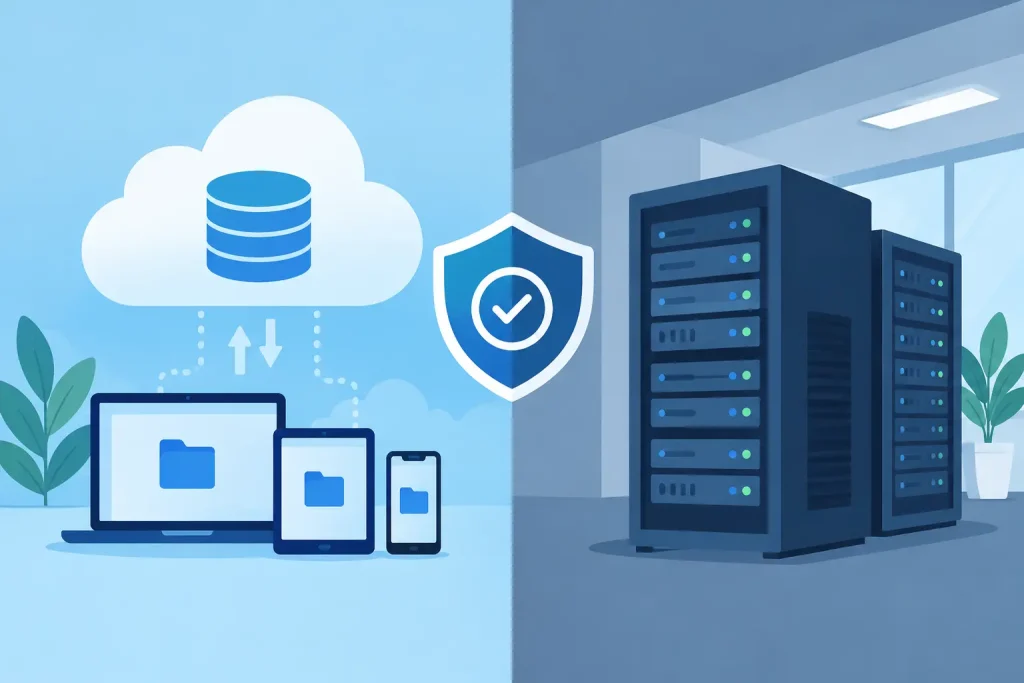

A clinic cannot pause patient intake because the Internet slows down at 2 p.m. A retailer cannot wait for a shared connection to recover while payment terminals are offline. That is why the dedicated internet vs broadband decision should be based on operational risk, not just the monthly circuit price.
For some locations, business broadband is a practical and cost-effective choice. For others, a dedicated Internet access circuit is a baseline requirement. The right answer depends on what happens when connectivity is degraded, who relies on the connection, and how much accountability your organization needs from its providers.
Dedicated internet vs broadband: the core difference
Business broadband is generally a shared-access service. Your location has a connection with defined download and upload speeds, but the provider’s local network capacity is shared among customers. Performance can vary by neighborhood, time of day, and network demand. Cable, fixed wireless, and many fiber-based business services fall into this category, although service designs vary by carrier.
Dedicated Internet access, often called DIA, is engineered differently. The carrier provisions a committed connection for your organization, typically over fiber, with a defined bandwidth level and enterprise service terms. Rather than competing with surrounding users for last-mile capacity, your business receives a dedicated path from the site into the carrier network.
That distinction changes more than speed. It affects consistency, repair expectations, scalability, and the ability to support applications that cannot tolerate unpredictable performance.
Bandwidth is only one part of the equation
A broadband plan may advertise fast download speeds, sometimes faster than a lower-cost dedicated circuit. That can make the comparison look simple on paper. It is not.
Dedicated Internet is usually symmetrical, meaning upload and download capacity are the same. This matters for cloud backups, video conferencing, hosted phone systems, security cameras, remote access, and applications that send data from the site to the cloud. Many broadband services provide far less upstream capacity than downstream capacity.
More importantly, dedicated service is designed around a committed level of performance. A speed test on a quiet morning does not reveal what happens during peak demand, when a site is pushing a large backup, or when multiple users are on video calls while a point-of-sale platform is processing transactions.
What your business is actually buying
The practical value of DIA is not simply a private circuit. It is a more accountable service model.
Dedicated circuits commonly include a service level agreement with measurable commitments around uptime, latency, jitter, packet loss, and time to repair. The exact terms differ by carrier and circuit type, so they should be reviewed before signing. Still, the presence of contractual performance standards gives IT and operations leaders a clearer escalation path when a connection fails.
Broadband providers may offer business support tiers, but their terms are often less stringent. Repair windows can be longer, service restoration may not be guaranteed in the same way, and support teams may treat an outage as a standard service ticket rather than an operational incident.
For a small professional office with a few cloud applications, that trade-off may be acceptable. For a senior living community relying on cloud-based clinical systems, voice, guest Wi-Fi, cameras, and staff communications, it may not be.
Reliability is more than the circuit type
A dedicated circuit can fail. Fiber can be cut, construction can damage a conduit, carrier equipment can have an issue, and a building’s internal network can become the point of failure. Buying DIA does not remove the need for network design and contingency planning.
The stronger approach is to match the primary connection to the site’s needs and then design for failure. A common model is dedicated fiber as the primary circuit, paired with broadband or wireless service from a separate carrier as failover. With properly configured firewalls, automatic failover, and monitoring, a single-carrier outage does not have to become a business outage.
Carrier diversity matters. Two circuits ordered from different brands may still share the same physical route or underlying infrastructure. A proper assessment considers the building entrance, last-mile route, carrier network, and failover behavior. This is where a carrier-neutral partner can identify options that a single provider is unlikely to present.
When broadband is the right business decision
Broadband is not automatically the lesser choice. It is often the right fit when the site has moderate traffic, limited business interruption exposure, and a realistic backup process.
A small administrative office, a temporary project site, or a low-traffic retail back office may be well served by business broadband. It can be deployed faster in some markets, cost less than DIA, and provide more than enough capacity for email, cloud productivity tools, and standard web use.
Broadband can also be a smart secondary connection. When it comes from a separate carrier and is monitored as part of a managed failover design, it provides meaningful resilience at a lower cost than a second dedicated circuit.
The mistake is treating a consumer-grade or lightly managed broadband connection as enterprise infrastructure when the site depends on it for revenue, safety, care delivery, or compliance-sensitive work.
When dedicated Internet is worth the investment
DIA is typically justified when poor connectivity creates an immediate operational, financial, or reputational consequence. Consider it for locations that depend on real-time cloud platforms, high call volumes, unified communications, large data transfers, or customer-facing systems that cannot be offline.
Healthcare and senior living organizations may need stable connectivity for electronic records, care coordination, VoIP, security systems, and resident communications. Financial organizations need consistent performance and clear accountability for secure, transaction-dependent operations. Multi-site retailers need reliable payment processing, inventory access, digital signage, and centralized management. Schools and commercial properties may require consistent Internet service across dense Wi-Fi environments with hundreds of users and devices.
DIA also becomes more compelling as a site grows. A connection that works for 20 employees can become a bottleneck after a move to cloud phones, security cameras, SaaS applications, and hybrid work. The question is not whether employees can browse the web. The question is whether the network can carry the organization’s most important workflows under normal and peak conditions.
Do not confuse dedicated Internet with cybersecurity
A dedicated circuit can improve performance predictability, but it does not secure the network by itself. Firewalls, endpoint protection, identity controls, network segmentation, secure remote access, and monitoring remain essential.
The same applies to managed Wi-Fi and voice. A poor Wi-Fi design can make a high-quality DIA circuit appear slow. An overloaded firewall, a misconfigured VLAN, or an unstable VoIP configuration can create symptoms that look like an Internet provider problem. One team that owns the whole stack can isolate the actual fault faster than a chain of vendors pointing at one another.
How to make the decision without guessing
Start with the cost of disruption. Ask what a one-hour outage would affect: revenue, patient care, payment acceptance, resident safety, employee productivity, tenant experience, or contractual obligations. Then determine which systems need Internet access and how much upstream traffic they generate.
Next, review the actual service options at each address. Availability is location-specific. One building may have multiple fiber providers and diverse entry paths, while another may have only cable and fixed wireless options. Do not assume a carrier’s advertised coverage means the same service level is available at every site.
Finally, compare total operating value rather than circuit cost alone. Include installation timelines, contract terms, static IP requirements, equipment ownership, service-level commitments, monitoring, failover design, and who will manage escalations during an outage. A cheaper connection that takes days to repair can become the more expensive decision quickly.
Build connectivity around the business, not the brochure
The best connectivity plan is usually not a blanket rule that every site needs DIA or that broadband is good enough everywhere. It is a documented standard based on site criticality, application demand, available carriers, and recovery requirements.
Southeast Networks helps organizations evaluate those variables across IT, connectivity, voice, Wi-Fi, and security so the circuit is not designed in isolation. That means real engineers, not a 1-800 black hole, when a site has an issue that crosses provider and network boundaries.
Choose broadband where its economics and performance fit the operation. Use dedicated Internet where consistency and accountability protect the business. Then make sure the network has a tested path forward when either connection fails.