
A cloud phone system review should begin with the moments when your business can least afford a missed call: a resident calling a senior living community after hours, a patient trying to reach a care team, or a retail location needing support during a payment outage. The question is not whether a platform has calling, messaging, and video features. Most do. The question is whether the complete voice environment will perform reliably across your locations, networks, devices, and support model.
For organizations with multiple sites or business-critical communications, cloud voice is an operational decision. It affects customer experience, staffing, security, business continuity, and accountability when something goes wrong. A low per-user price can look attractive until a carrier circuit degrades, an emergency call is routed incorrectly, or employees spend hours trying to determine whether the phone provider, Internet provider, or IT team owns the problem.
What a cloud phone system review should measure
A useful evaluation goes beyond a feature checklist. It measures the system against the conditions your organization actually operates in: busy call periods, remote work, power interruptions, site openings, carrier outages, and staff turnover.
Start with call quality. Voice traffic is sensitive to latency, jitter, packet loss, and inconsistent Wi-Fi. A provider can demonstrate excellent audio from a controlled office connection while a branch location experiences dropped calls over an overloaded circuit. Review the network path at every site, including Internet capacity, router performance, switching, Wi-Fi coverage, traffic prioritization, and failover connectivity. If voice shares bandwidth with guest Wi-Fi, cameras, cloud backups, or point-of-sale traffic, the design must account for it.
Uptime deserves the same scrutiny. Cloud platforms reduce dependence on an on-premises phone server, but they do not eliminate dependencies. Calls still rely on local power, network equipment, Internet circuits, endpoint devices, and the provider’s service architecture. Ask what happens when a primary circuit fails, when a site loses power, or when a local network device goes offline. A credible design identifies failure points and provides a tested path around the ones that matter.
Security is equally practical. Voice systems hold call records, voicemail, user identities, forwarding rules, and sometimes sensitive recordings. They are also frequent targets for account takeover and toll fraud. Confirm how the provider handles multifactor authentication, role-based administration, audit logs, encryption, fraud monitoring, and rapid response to suspicious calling patterns. Healthcare, financial services, and education organizations should also verify whether recording, retention, and access controls align with their compliance obligations.
Evaluate the phone system as part of the stack
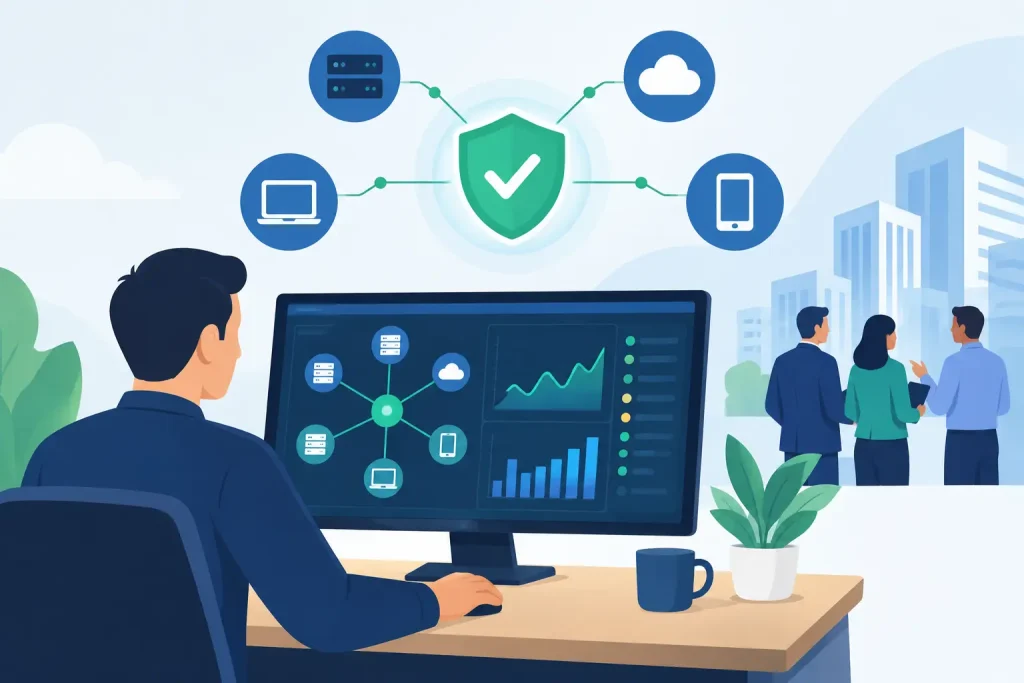
A cloud phone system does not operate in isolation. Its success depends on the technology environment around it. This is where many reviews become too narrow.
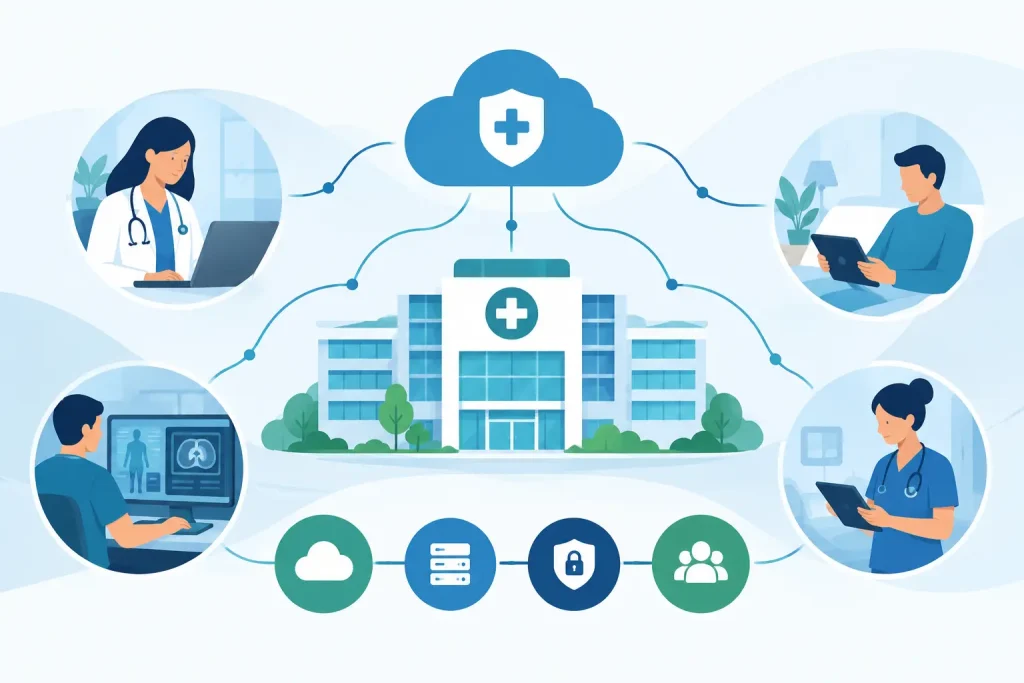
Consider a growing outpatient clinic opening two new locations. The phone platform may support auto attendants, queues, mobile apps, and integrations with the tools the clinic uses. But the deployment can still fail if carrier installation dates slip, the local network is not configured for voice traffic, front-desk devices arrive without a provisioning plan, or the team has no process for after-hours routing. The platform was never the whole project.
The same is true for multi-site retail, commercial properties, and senior living communities. Each environment has different call flows, staff roles, network conditions, and emergency requirements. A property management office may need reliable mobile answering and clear escalation paths. A senior living campus may need dependable common-area phones, paging integration, and location-specific emergency calling. A financial office may prioritize recording controls and secure administration. The right system is the one designed around those operating realities.
When reviewing providers, determine who owns the handoffs. If one vendor sells phones, another manages the network, a third supplies Internet service, and a fourth handles IT support, troubleshooting can become a chain of tickets and finger-pointing. The delay is not merely frustrating. It can leave customers, residents, and employees unable to reach the people they need.
A managed partner that understands voice, connectivity, and the local network can isolate issues faster because it sees the full path of a call. That does not mean every organization needs one vendor for every technology decision. It does mean the accountability model should be clear before deployment, not negotiated during an outage.
Test the scenarios that expose weaknesses
Product demonstrations are useful, but they rarely reveal how a system behaves under pressure. Ask the provider to walk through real scenarios using your call flows and locations.
First, test failure routing. If the main office loses Internet access, can inbound calls automatically route to mobile devices, another site, or a temporary answering group? How quickly does that change occur, and who has permission to activate it? Automatic failover is valuable, but it must be configured correctly and regularly tested.
Next, test emergency calling. Confirm that emergency services receive the correct physical address and, where applicable, building, floor, or suite information. This is especially significant for multi-building campuses, multi-tenant properties, and organizations with employees who move between locations. Review the process for updating addresses when staff relocate or new sites open. An emergency calling record that was correct at implementation can become inaccurate over time.
Then test call handling during peak demand. Measure queue behavior, overflow rules, abandoned calls, callback options, and supervisor visibility. A contact center may need detailed analytics. A smaller office may only need a clear way to see whether calls are being answered and where missed calls go. Avoid paying for advanced tools your teams will not use, but do not under-specify the functions that protect revenue, service levels, or safety.
Finally, test administration and support. Create a new user, change a call queue, assign a device, reset credentials, and modify after-hours routing. The process should be controlled without becoming dependent on a single internal employee or a slow vendor ticket. Ask for stated response commitments, escalation procedures, and the support team’s scope. Real engineers, not a 1-800 black hole, matter when voice is down at a critical site.
Separate useful features from expensive distractions
Cloud phone vendors often compete on broad feature lists. AI summaries, video meetings, team chat, advanced analytics, contact center tools, and extensive integrations may all be valuable. They are not automatically valuable to every organization.
Build requirements from business outcomes first. For example, a regional business may need consistent dialing plans across locations, centralized administration, reliable call queues, mobile continuity, and transparent reporting. A healthcare group may also need secure voicemail practices, clear on-call routing, and documentation that supports its compliance program. A property portfolio may need a repeatable deployment model for newly acquired buildings.
Once those needs are clear, classify features as required, useful, or optional. This protects the budget and keeps deployment focused. It also prevents a common mistake: selecting a sophisticated platform that staff do not adopt because its daily workflows are more complicated than the system it replaced.
Licensing deserves careful attention. Compare named-user, device, common-area, contact center, and add-on charges. Ask how seasonal staffing, temporary users, shared phones, and future locations are handled. Review contract terms, price increases, porting responsibilities, implementation fees, and early termination conditions. Predictable billing is part of a sound technology decision, particularly when voice service spans a distributed organization.
Questions that reveal provider accountability
A provider should be able to answer direct questions without relying on general assurances. Ask who manages number porting and what happens if a port date is delayed. Ask who validates network readiness before go-live. Ask whether they monitor the service experience after deployment or only respond when users report a problem.
Also ask where support begins and ends. Some providers support the cloud application but not desk phones, local networks, Internet circuits, or third-party integrations. That model may work for a well-staffed internal IT department. For organizations that need one accountable team, it creates operational gaps.
Southeast Networks approaches voice as part of the managed environment, not as a standalone subscription. That means assessing the connectivity and network conditions that determine call performance, coordinating deployment details, and maintaining a clear ownership path when service is affected. The objective is straightforward: fewer vendors to coordinate and faster resolution when communications are at risk.
Make the final decision on operating fit
The best cloud phone system is not necessarily the one with the longest feature list or the lowest advertised price. It is the system that supports your call patterns, survives the failures you can reasonably expect, protects sensitive information, and comes with an accountability model your team can rely on.
Before signing, document the proposed design, locations, emergency addresses, failover paths, support contacts, implementation milestones, and acceptance tests. Treat the go-live as the beginning of an operating relationship, not the finish line of a purchase. A phone system earns its value on the day a customer needs an answer, a site loses connectivity, or a critical call has to reach the right person without delay.