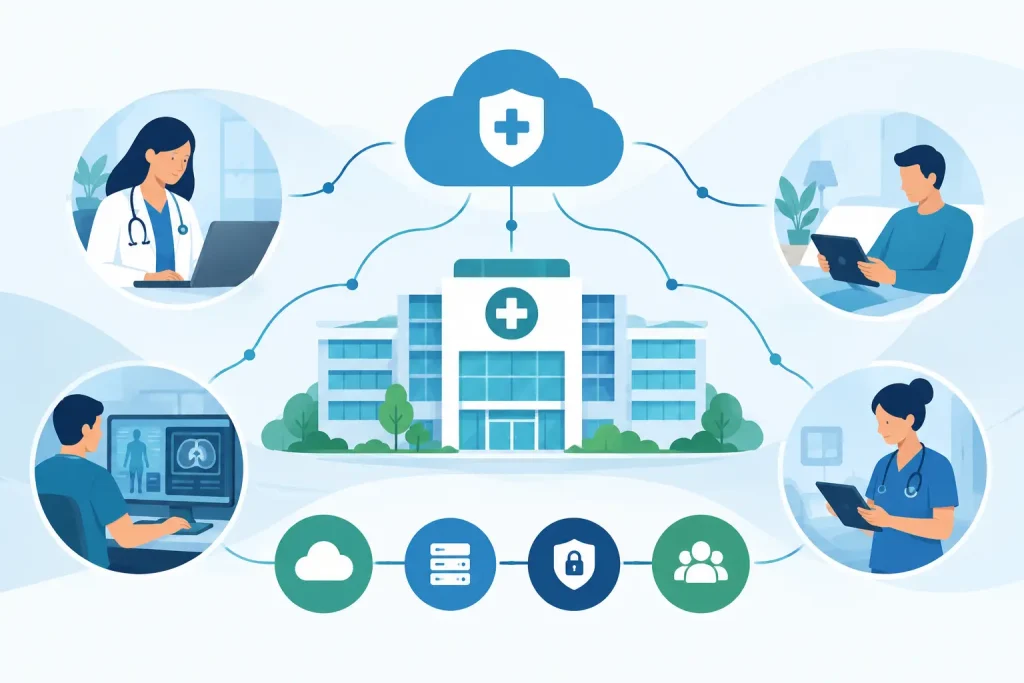

A clinician cannot wait for a carrier ticket to move through three vendors while the EHR stalls, VoIP phones fail, and a satellite clinic loses access to shared records. A healthcare network modernization example is useful when it shows more than new switches or faster Internet. It should show how an organization rebuilds accountability around the systems that keep care moving.
For healthcare leaders, modernization is an operational decision. The network supports clinical documentation, medication workflows, imaging access, patient communications, guest Wi-Fi, building systems, security cameras, and the administrative work behind every appointment. When that foundation is fragmented, even a short outage creates clinical friction, staff overtime, patient dissatisfaction, and compliance exposure.
The Starting Point: A Network Built in Pieces
Consider a regional healthcare organization with a main outpatient center, four specialty clinics, and two administrative offices. It had grown through acquisitions and lease expansions. Each location made reasonable technology decisions at the time, but no one designed the environment as one system.
The main site had a business fiber circuit, a firewall managed by a local IT firm, aging switches, and a separate voice provider. Two clinics relied on broadband connections with no meaningful failover. Another had an independently purchased firewall that had not received a documented configuration review in years. Wi-Fi names, device policies, and support contacts varied by location.
The organization also had a familiar accountability problem. The carrier owned the circuit, the voice provider owned the phones, an outside IT company owned endpoints, and internal staff were expected to coordinate every incident. When staff reported intermittent EHR performance, each vendor pointed elsewhere. No one owned the patient-facing outcome.
Modernization began with a question more useful than, “Which hardware should we buy?” The leadership team asked: Which clinical and business functions must remain available at every location, and who is accountable when they do not?
Healthcare Network Modernization Example: The Design
The assessment identified three priorities: stabilize connectivity, segment traffic according to risk and function, and create one support model for the full environment. The goal was not to replace every piece of equipment at once. It was to remove the single points of failure and blind spots that made ordinary issues disruptive.
Connectivity Designed for Outages, Not Just Normal Days
At the main outpatient center, the organization deployed diverse primary and secondary Internet connections. Diversity mattered more than simply adding a second circuit. Two services delivered through the same local facility or dependent on the same upstream path may not protect against the same physical failure.
The clinics received right-sized primary connectivity with cellular or fixed wireless failover where a second wired path was not practical. Automatic failover was tested during planned maintenance windows, not assumed to work because the hardware supported it.
This decision involved trade-offs. A fully diverse fiber design offers stronger protection but may not be available or financially justified at every small clinic. For a low-volume administrative site, cellular backup may be the appropriate recovery path. For a high-volume imaging center or urgent care location, the cost of downtime can justify a more resilient design. The architecture should follow operational impact, not a standard equipment list.
Network Segmentation That Reflects Care Delivery
The prior environment placed too many systems on broadly shared networks. Staff devices, printers, cameras, guest wireless users, building controls, and certain clinical devices could communicate more freely than necessary. That increased both troubleshooting complexity and the potential impact of a compromised endpoint.
The new design separated traffic into managed network segments with clear rules between them. Clinical workstations, administrative users, voice services, medical and IoT devices, guest Wi-Fi, and facilities systems each received defined access policies. The purpose was practical: a guest device should not be able to reach an internal system, and a malfunctioning camera should not interfere with clinical traffic.
Segmentation is not a one-time checkbox. Medical devices can have vendor-specific communication requirements, legacy operating systems, or maintenance limitations. A rushed policy change can interrupt a device that clinicians depend on. The implementation team documented dependencies, tested changes with affected stakeholders, and used phased cutovers rather than making a broad change after hours and hoping for the best.
Security and Visibility at the Edge
Next-generation firewalls were standardized across sites and placed under centralized management. Security policies, firmware schedules, threat monitoring, remote-access controls, and alerting became consistent rather than location-specific.
Central visibility changed the support experience. Engineers could see circuit status, firewall events, wireless health, and core network performance from one operating view. That shortened triage when a clinic reported a problem. Instead of asking whether the carrier, Wi-Fi vendor, or phone provider might be responsible, the support team could isolate the failure domain and take ownership of escalation.
For healthcare organizations, this also supports better governance. Documented configurations, access controls, change records, and incident response procedures make it easier to demonstrate that infrastructure is being actively managed. Technology alone does not create compliance, but unmanaged infrastructure makes compliance far harder to defend.
Migration Without Disrupting Patient Care
A modernization plan can fail if deployment is treated as a weekend hardware swap. The organization used a location-by-location approach tied to patient schedules and operational risk.
First, engineers completed an inventory of circuits, network equipment, wireless coverage, connected devices, voice dependencies, and vendor contracts. They confirmed which systems were truly business-critical and which could tolerate an interruption. This exposed several forgotten services, including an old backup circuit still being billed and a wireless bridge supporting a facilities application.
Each site then received a documented cutover plan, validation checklist, rollback procedure, and named contacts for operations and clinical leadership. Major changes occurred outside high-volume hours, but testing continued when actual staff were available to validate EHR access, printing, calling, wireless roaming, and device connectivity.
The organization did not wait for the entire project to finish before seeing improvement. The highest-risk sites received connectivity and firewall remediation first. That sequencing reduced exposure early while allowing the broader standardization work to proceed without forcing an unrealistic all-at-once deadline.
What Changed After Modernization
The strongest result was not a speed-test number. It was a change in operational control.
When a primary circuit experienced a service interruption, designated locations failed over as designed and staff retained access to required cloud applications. When a suspicious endpoint event occurred, segmentation limited its reach and centralized monitoring provided a clear investigation path. When users reported poor call quality, the team could evaluate the circuit, LAN, Wi-Fi, and voice configuration together rather than opening unrelated tickets.
The finance team gained better visibility as well. Consolidating service ownership did not mean every service had to come from one carrier. Carrier-neutral sourcing allowed the organization to select the right access option by site while receiving clearer billing and fewer vendor handoffs. Existing contracts were reviewed before replacement, helping leadership avoid unnecessary early-termination costs.
Most importantly, internal leaders no longer served as the relay point between vendors. They had one team accountable for the whole stack – connectivity, network, security, voice, and ongoing support. For organizations with limited internal IT resources, that distinction is often more valuable than any individual appliance.
What Healthcare Leaders Should Measure
Modernization should be judged by service outcomes, not by how much equipment was installed. Healthcare organizations should track circuit availability, failover performance, mean time to acknowledge and resolve incidents, recurring trouble-ticket categories, wireless coverage issues, security events, and the number of vendors involved in a typical outage.
It also helps to measure operational disruption in plain terms. How often do clinicians report application interruptions? How long can a site function when its primary connection fails? Can the organization identify every device connected to the network? Are configuration changes documented and recoverable? These answers reveal whether the environment is actually becoming more resilient.
Southeast Networks approaches this work as an ownership problem as much as a technology problem. The right design connects managed IT, carrier services, cybersecurity, voice, and recovery planning under one accountable operating model. Real engineers should be able to see the issue, coordinate the fix, and explain what happened without sending staff into a 1-800 black hole.
The useful lesson from any healthcare network modernization example is simple: build for the moment something fails. When the network has clear ownership, tested recovery paths, and policies that match how care is delivered, technology becomes less of a daily distraction and more of a dependable part of patient operations.