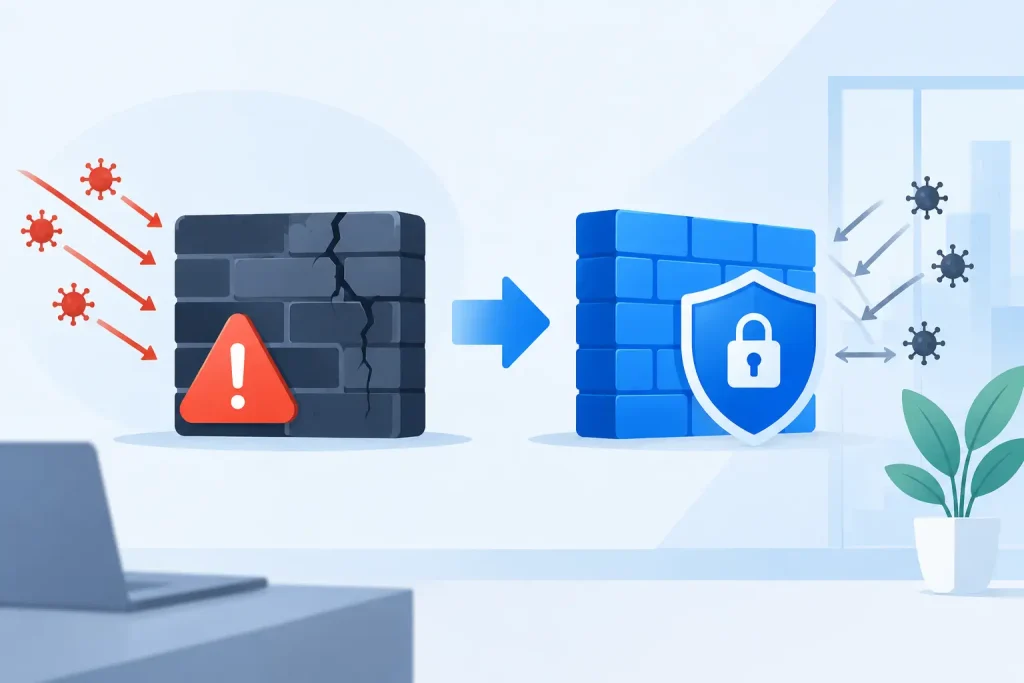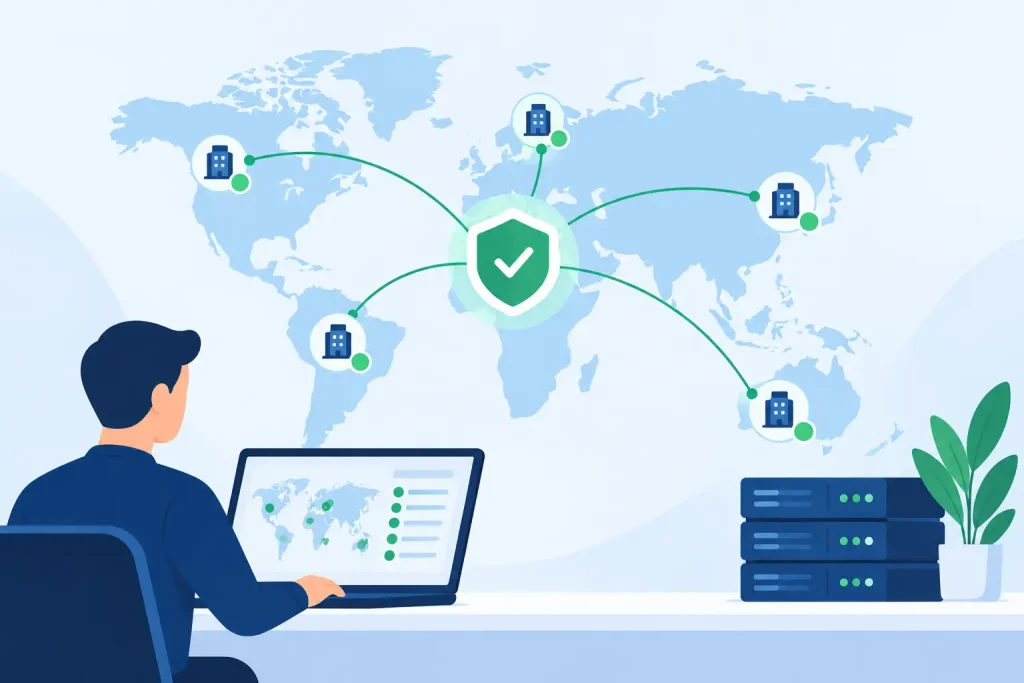

A firewall decision that works for one office can become an operational liability at 10, 50, or 200 locations. Local exceptions multiply, policy drift creeps in, and an outage at a branch turns into a scramble across ISPs, IT vendors, and equipment manufacturers. The best multi location firewall solutions do more than block threats. They give your organization consistent policy control, clear visibility, and a support model that holds up when a location cannot afford to be offline.
For healthcare, senior living, retail, financial services, education, and distributed commercial operations, the right answer is rarely just a box installed at every site. It is an architecture that connects security, connectivity, management, and response ownership.
What Multi-Location Firewall Management Must Solve
A distributed firewall environment has to protect each site without requiring your internal IT team to administer every device individually. That sounds straightforward until locations have different circuit providers, applications, compliance requirements, guest Wi-Fi needs, and local operating hours.
A strong design starts with centralized management. Security policies, web filtering, intrusion prevention, VPN settings, and software updates should be administered from a single control plane. That does not mean every site receives an identical configuration. It means site-specific rules are intentional, documented, and governed rather than created ad hoc after a local issue.
Visibility matters just as much. Operations and IT leaders need to see whether a site is experiencing a security event, a failing circuit, excessive bandwidth consumption, or an application issue. A firewall can identify traffic patterns, but it cannot resolve a carrier outage on its own. The best deployments connect firewall monitoring with circuit oversight and a defined escalation process.
The Cost of Policy Drift
Policy drift occurs when individual locations gradually operate under different security rules. One site has an outdated firmware version. Another has an open port created for a vendor years ago. A third uses a consumer-grade router because a replacement was needed quickly. Each exception may seem manageable alone. Across a portfolio, they create an inconsistent and difficult-to-defend security posture.
Central templates, controlled change management, and periodic configuration reviews reduce that risk. They also make acquisitions, new openings, and relocations far easier to support.
Best Multi Location Firewall Solutions: The Main Models
There is no universal firewall platform that wins in every environment. The right model depends on the number of locations, application mix, internal technical resources, regulatory obligations, and tolerance for operational complexity. Most organizations will evaluate one of four approaches.
Managed Next-Generation Firewalls
A managed next-generation firewall, or NGFW, is often the most practical choice for organizations that need enterprise-grade controls but do not want to staff a dedicated network security operations function. These platforms commonly combine application-aware filtering, intrusion prevention, malware inspection, VPN capabilities, segmentation, and centralized policy management.
The benefit is not only the feature set. It is having a defined team responsible for monitoring, patching, configuration backup, rule review, and incident escalation. That accountability is especially valuable when a site has both network and connectivity problems. A managed provider can determine whether the issue is the firewall, the local network, the carrier circuit, or an upstream service before passing the problem between vendors.
The trade-off is that managed service quality varies widely. Ask who monitors alerts, what is included in change requests, how firmware updates are scheduled, and who owns carrier coordination during an outage. A dashboard alone is not managed security.
SD-WAN With Integrated Security
Secure SD-WAN combines traffic steering, path selection, and firewall capabilities across multiple WAN connections. It is well suited to distributed organizations where uptime depends on more than one connection type, such as fiber with cable, wireless failover, or another diverse path.
This model can prioritize critical applications, route voice traffic over the healthiest path, and fail over automatically when a circuit degrades. For a retail site, that may protect payment processing and point-of-sale operations. For a senior living community, it may preserve access to care-related systems and voice communications when a primary circuit fails.
The key question is whether the platform’s native security features meet your requirements or whether it should be paired with a dedicated firewall service. Integrated security can simplify deployment, but organizations with demanding segmentation, inspection, or compliance needs may require deeper controls at the edge.
Cloud-Managed Firewalls
Cloud-managed firewalls are designed for simplicity. They can be deployed quickly, configured centrally, and monitored through a web-based portal. For smaller branch environments with limited local infrastructure, this approach may offer an efficient balance of control and cost.
They are particularly useful when locations have similar needs: standardized Wi-Fi, basic segmentation between business and guest networks, remote access, and consistent content filtering. However, simplicity can become a limitation in complex environments. If you need advanced traffic inspection, detailed application controls, extensive integrations, or highly granular multi-tenant segmentation, evaluate the platform carefully before standardizing.
Firewall-as-a-Service and Secure Access Service Edge
Firewall-as-a-Service, often delivered as part of a Secure Access Service Edge or SASE strategy, moves more security enforcement into the cloud. Rather than relying entirely on appliances at each location, traffic may be routed through cloud security points of presence for inspection and policy enforcement.
This approach is compelling for organizations with a large remote workforce, cloud-first applications, and frequent site changes. It can provide consistent security for users whether they are at headquarters, a branch office, or working remotely.
It also introduces dependency on Internet path quality and cloud service availability. For locations running latency-sensitive workloads, local Internet breakout and direct cloud inspection must be designed carefully. SASE is a strong strategic option, not an automatic replacement for every on-premises firewall.
How to Evaluate a Firewall Platform Beyond Features
Feature comparisons are useful, but they rarely reveal whether a solution will perform under real operating conditions. The decision should be grounded in business continuity and ownership.
Start with application requirements. Identify the systems each location cannot lose: payment platforms, electronic health records, VoIP, building access controls, learning platforms, security cameras, or line-of-business cloud applications. Then determine their bandwidth, latency, inspection, and failover needs. A firewall sized only for current Internet speed may become a bottleneck as encrypted traffic inspection and cloud usage increase.
Next, assess segmentation. A multi-location environment should separate corporate users, guest Wi-Fi, IoT devices, surveillance systems, payment systems, and sensitive operational networks where appropriate. Segmentation limits the blast radius of a compromised device. It also supports cleaner compliance boundaries, particularly for organizations handling financial, health, or student data.
Finally, examine operational support. The best technology cannot compensate for unclear responsibility at 2:00 a.m. when a site loses connectivity. Your agreement should define monitoring coverage, response targets, hardware replacement procedures, configuration ownership, and carrier escalation. Real engineers, not a 1-800 black hole, make the difference when downtime is already affecting operations.
Build for Circuit Failure, Not Just Cyber Threats
Firewall planning and connectivity planning should not be separate projects. A firewall is the decision point for how traffic behaves when the primary circuit fails, degrades, or becomes unavailable. If your provider does not own both sides of that discussion, your team may be left coordinating the response.
A resilient design commonly includes primary and secondary connections from diverse providers or technologies, automated failover, proactive circuit monitoring, and documented testing. Diversity matters more than simply having two circuits. Two services delivered through the same facility path, central office, or local construction zone may fail together.
Failover also needs application-aware testing. A secondary connection may keep Internet access alive while degrading voice quality, disrupting VPN tunnels, or causing cloud applications to time out. Test the business workflows, not just whether a ping succeeds.
A Practical Deployment Standard for Every Site
Standardization should create repeatability without ignoring local requirements. A useful site standard includes a documented network diagram, approved firewall model and license level, segmented network design, primary and backup circuit plan, configuration template, monitoring enrollment, and an escalation contact list.
Before deployment, conduct a site assessment that accounts for circuit availability, demarcation location, power protection, rack space, Wi-Fi coverage, and local equipment dependencies. During deployment, capture the final configuration and test both security policy and failover behavior. After go-live, maintain a regular cadence for firmware, rule cleanup, capacity review, and recovery testing.
For organizations opening locations rapidly, this standard becomes a launch playbook. It reduces surprises, gives finance a clearer view of recurring costs, and ensures every new site begins with the same security and continuity baseline.
Choosing a Partner That Owns the Whole Stack
Multi-location firewall projects fail when security, networking, carrier services, and support are purchased as isolated components. The equipment may be capable, but ownership is fragmented. During an incident, each vendor can point to another layer of the environment.
Look for a partner that can assess the site, source carrier-neutral connectivity, deploy and manage the firewall, support the LAN and Wi-Fi environment, and coordinate recovery when an outage crosses vendor boundaries. Southeast Networks approaches distributed infrastructure this way: one team accountable for the technology environment rather than a collection of disconnected contracts.
The right firewall solution is the one your organization can operate consistently, support confidently, and recover through under pressure. Start with the applications and locations that cannot go down, then build the security and connectivity design around keeping them available.