
A vendor review often starts after something breaks: a circuit fails, a security alert goes unanswered, an invoice cannot be explained, or one provider blames another. That is the wrong time to discover that no one owns the outcome. To audit business IT vendors effectively, evaluate the full operating model behind each service, not just the monthly price or the promises made during a sales call.
For multi-site healthcare, senior living, retail, financial, education, and commercial property organizations, technology vendors affect far more than the IT department. Their performance determines whether staff can communicate, residents can receive care, tenants can connect, transactions can clear, and operations can continue during an outage. A disciplined vendor audit turns that risk into a clear plan for accountability.
Start With the Business Services That Cannot Stop
An effective audit begins with operations, not a vendor spreadsheet. Identify the services that would cause immediate disruption if they failed for an hour, a day, or longer. This may include internet connectivity, phones, cloud applications, wireless networks, point-of-sale systems, access control, electronic health records, and backup systems.
For each service, document the location, business owner, technical owner, dependent systems, and acceptable downtime. A primary internet circuit, for example, may support phones, guest Wi-Fi, payment systems, security cameras, and remote access. If its failure affects all five, it should not be evaluated as a simple connectivity line item.
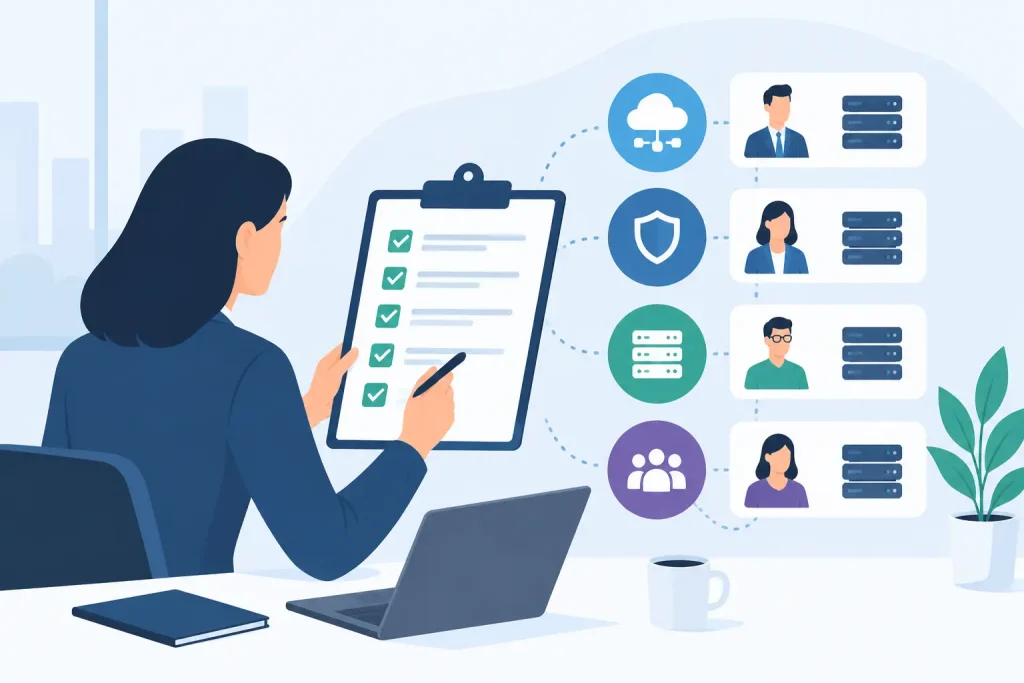
This exercise reveals a common issue: vendors are often managed in silos while their failures are felt across the business. The carrier may own the circuit, an IT provider may manage the firewall, a voice company may support the phones, and an internal team may be left to coordinate the incident. Each contract can look reasonable on its own. Together, they can create an operational gap.
Build a Complete Vendor and Service Inventory
Do not rely only on accounts payable records. Finance records are necessary, but they rarely show who actually supports a service, what equipment is in scope, or whether contracts have quietly rolled over. Build one inventory that connects vendors to services, locations, contracts, assets, costs, and escalation contacts.
At a minimum, capture the following for every vendor relationship:
- Services delivered and every site or department covered
- Contract term, renewal date, cancellation notice period, and price escalation terms
- Named service-level commitments for response, restoration, uptime, and support availability
- Equipment ownership, including firewalls, switches, access points, phones, and carrier handoff devices
- Administrative access, licensing ownership, and the location of configuration documentation
- Escalation contacts for routine support, major incidents, billing disputes, and executive review
The goal is not paperwork for its own sake. It is to expose dependencies before an outage or contract renewal makes them urgent. If no one can identify the administrator for a firewall, retrieve a network diagram, or explain who pays for a failed router, the business has an unmanaged risk.
Audit Business IT Vendors Against Ownership
The central question in an audit is simple: when a business-critical service fails, who owns resolution from the first call through restoration? A vendor that only owns a narrow product may still be the right fit, but the handoffs must be explicit.
Ask every provider where its responsibility starts and ends. Then compare those answers across the stack. A managed IT partner may say the internet provider owns the outage. The carrier may say its circuit tests clean to the demarcation point. Meanwhile, the firewall could be offline, the backup circuit may not be configured for failover, or DNS may be preventing applications from reaching the internet.
None of those statements are necessarily wrong. The problem is allowing the customer to serve as the integration layer. For organizations with limited internal IT resources, this structure creates long restoration times and inconsistent accountability.
A stronger model identifies one accountable party for each end-to-end service. That party does not need to manufacture every component or own every contract. It does need the authority, documentation, monitoring, and escalation path to coordinate the full incident. One team that owns the whole stack reduces finger-pointing when time matters.
Test Support With Realistic Scenarios
Do not judge support solely by ticket response statistics. Ask vendors to walk through actual failure scenarios: a primary circuit outage, ransomware detection, failed backup recovery, degraded Wi-Fi at one location, or a phone system outage during business hours.
Listen for specifics. Who answers first? What diagnostics are performed? Who opens the carrier ticket? How is leadership updated? When does the vendor declare a major incident? What happens if the issue crosses multiple systems? Strong providers can explain the process clearly, including where their responsibility ends and how they manage the next handoff.
If a vendor’s answer is essentially “call us and we will see,” that may be acceptable for a low-impact service. It is not sufficient for infrastructure that supports patient care, revenue, safety, or tenant operations.
Verify Security, Resilience, and Recovery Claims
Security and continuity services are easy to overstate because their value is most visible when something goes wrong. Audit the evidence behind the claims.
For cybersecurity providers, review what is actually monitored, who responds after hours, how incidents are escalated, and whether endpoint, identity, email, network, and backup controls are coordinated. A security product is not the same as a managed security process. Confirm that alert ownership is defined and that critical findings do not sit in an unattended portal.
For connectivity and disaster recovery, verify the design rather than accepting the label “redundant.” Two circuits entering the same building path or terminating on the same network equipment may not provide meaningful resilience. A backup internet connection is useful only if failover is configured, tested, and capable of supporting the applications that must remain online.
Recovery deserves the same scrutiny. Ask when backups were last tested, how long a restoration took, whether the results were documented, and which systems were included. A backup that exists but cannot be restored within the business’s recovery window is not a continuity plan.
Separate Commitments From Assumptions
Many vendor relationships operate on assumptions that were never written down. The customer assumes 24/7 support means an engineer will work a critical issue overnight. The provider may define support as a call center that creates a ticket. The customer assumes equipment replacement is included. The provider may charge time, materials, and expedited shipping.
Review service-level agreements, statements of work, and renewal documents for measurable terms. Look for response and restoration targets, maintenance windows, exclusions, after-hours coverage, reporting obligations, and financial remedies. More importantly, determine whether those commitments match the service’s business impact.
A lower-cost provider with limited support may be appropriate for a noncritical application. For a core circuit or security service, the cost of downtime can quickly outweigh any savings. The right decision depends on the service, its dependencies, and the organization’s tolerance for disruption.
Review Financial Control and Contract Risk
Vendor audits should give finance leaders as much clarity as IT leaders. Compare invoices against the service inventory and identify duplicate services, unused licenses, expired locations, unapproved rate increases, and equipment charges that no one recognizes.
Pay close attention to contract timing. Telecom and managed service agreements can include automatic renewals, long notice periods, early termination fees, and pricing that changes after an introductory period. Missing a notice deadline can lock an organization into another term before it has evaluated alternatives.
Also review vendor concentration. Consolidating services can reduce friction and simplify billing, but concentration creates risk if the partner lacks depth, documentation, or operational discipline. The answer is not always more vendors. It is a clear architecture, tested contingency plans, and a partner capable of managing services across providers when necessary.
Turn Findings Into an Accountable Action Plan
A useful audit produces decisions, not a binder of observations. Rank findings by business impact, likelihood, urgency, cost, and effort. Address high-impact ownership gaps first: unsupported firewalls, untested backups, single points of failure, unknown administrator credentials, and contracts approaching renewal without a sourcing plan.
Assign an owner and deadline to every action. Some fixes are immediate, such as updating escalation contacts or securing administrative access. Others require design work, budget approval, or a phased migration. Keep the plan practical and review it regularly with operations, IT, and finance stakeholders.
Southeast Networks approaches this work as an operational assessment, connecting managed IT, carrier services, security, voice, and recovery planning under accountable oversight. The objective is not to replace every vendor automatically. It is to establish a technology environment where responsibilities are clear, service performance is measurable, and an outage does not become a vendor-management exercise.
The best time to examine a vendor relationship is while services are stable and decisions can be made deliberately. Build the inventory, test the handoffs, verify the recovery evidence, and make ownership visible. When the next disruption arrives, your team should know exactly who is working the problem and who is accountable for getting the business back online.