
A breach rarely announces itself with a clear alert and a neat list of affected systems. It may begin with an unusual login, a finance employee reporting a suspicious email, a ransomware note, or a vendor notifying your team that credentials were exposed. The quality of your data breach response steps determines whether that initial signal becomes a contained incident or a prolonged operational and compliance failure.
For healthcare, financial services, senior living, education, retail, and multi-site organizations, response is not only an IT exercise. It affects patient care, resident safety, payment processing, customer trust, insurance requirements, contractual obligations, and the ability to keep locations operating. The objective is not to make a crisis look tidy. It is to make sound decisions quickly, preserve options, and restore services without destroying the evidence needed to understand what happened.
Start with authority, not activity
The first hour creates a common problem: many people begin working, but nobody has clear authority to decide what gets isolated, who communicates externally, or when a business system can return to service. That confusion costs time and can increase exposure.
Activate a defined incident leadership group immediately. At minimum, this should include the executive accountable for business continuity, the IT or security lead, legal counsel, compliance or privacy leadership where applicable, communications leadership, and the operational owner of the affected service. If a managed provider is involved, assign a named technical incident lead with authority to coordinate infrastructure, connectivity, endpoint, identity, and backup teams.
Establish one incident record, one communication channel, and a simple cadence for updates. Record the time the issue was detected, who reported it, systems believed to be affected, actions taken, and decisions made. A clean timeline is valuable for forensic review, insurance claims, regulatory reporting, and the practical work of preventing the same failure from recurring.
Avoid broad internal speculation. Employees need clear direction about what they should and should not do, especially if phishing, compromised accounts, or payment fraud may be involved. They do not need unverified explanations sent through email or chat.
Data breach response steps: contain the exposure
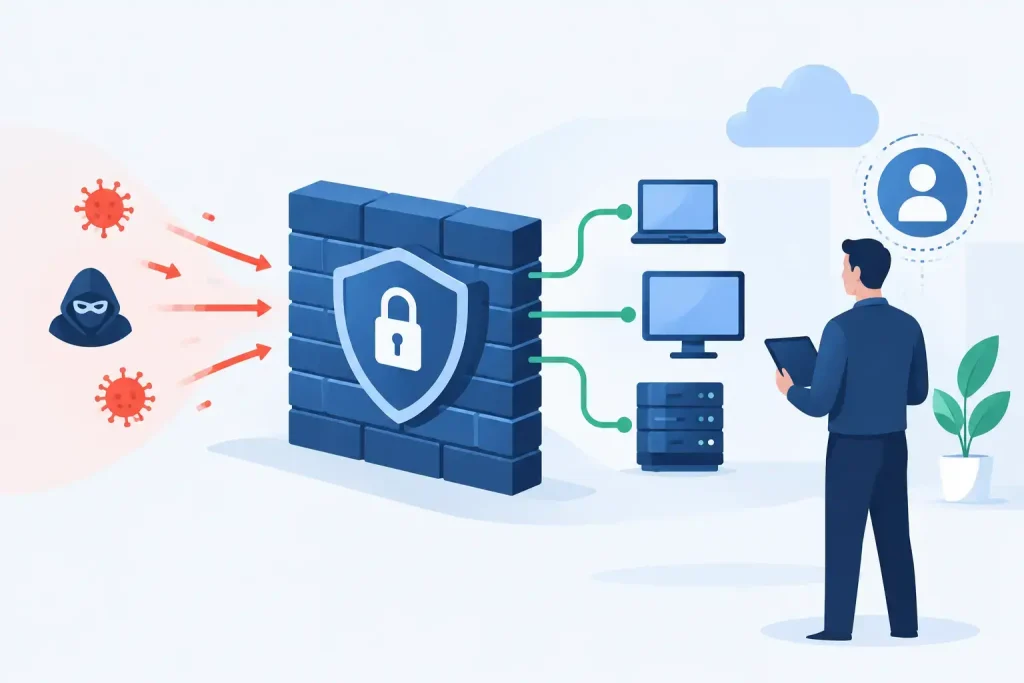
Containment comes before convenience. A system that appears to be functioning may still be transferring data, accepting attacker commands, or spreading malware through shared services. The response team must limit that activity while preserving essential operations where possible.
The right containment action depends on the incident. Disconnecting an infected workstation may be appropriate. Taking down an entire network without understanding dependencies may interrupt clinical systems, access control, voice services, or site operations. Segment first when possible, then expand isolation as evidence requires.
Core actions often include:
- Disable or reset credentials that may be compromised, with priority given to privileged accounts, remote access, email administrators, and service accounts.
- Isolate affected endpoints, servers, virtual machines, wireless segments, and remote access paths from the rest of the environment.
- Block confirmed malicious domains, IP addresses, forwarding rules, and suspicious mailbox access while preserving logs.
- Suspend risky integrations or data transfers if they may be exporting information or carrying the compromise into connected systems.
- Preserve backup repositories and administrative access to them before beginning large-scale recovery activity.
Do not wipe a device simply because it is infected. Rebuilding may be necessary, but premature wiping can erase artifacts that explain the attacker’s path, the data accessed, and the systems that remain at risk. If an endpoint must be taken out of service quickly, document its state and preserve available logs, memory captures, or disk images through qualified responders.
Determine what happened and what is at stake
A breach investigation should answer practical questions, not produce a pile of disconnected alerts. What initial access method was used? Which accounts, devices, applications, and network paths were involved? Did the intruder access, copy, alter, or encrypt data? Are they still active? What business processes depend on the affected systems?
This is where fragmented technology ownership creates real risk. Identity logs may sit with one provider, firewall telemetry with another, cloud records with a third, and Internet circuit details with a carrier. During an incident, every handoff introduces delay. One team that can see and manage the whole stack can correlate the evidence faster and make containment decisions with fewer blind spots.
Prioritize evidence sources based on the suspected entry point. For a compromised email account, review sign-in logs, mailbox rules, OAuth application permissions, sent messages, and lateral movement into file-sharing platforms. For ransomware, assess endpoint telemetry, domain controller activity, remote management tools, backup access, file server behavior, and unusual network traffic. For a suspected vendor event, identify the integration, credentials, data fields, access scope, and logs that show how the connection was used.
Scope should be treated as provisional until the evidence supports confidence. Affected data may include protected health information, payment data, student records, employee information, financial documents, proprietary files, or credentials. Classification matters because notification, contract, insurance, and regulatory obligations vary by data type, location, and industry.
Keep the business running safely
Business continuity and investigation can pull in different directions. Operations leaders want systems back. Security teams want time to validate that they are clean. Both needs are legitimate, and the response plan should set priorities before an incident forces rushed trade-offs.
Identify the services that cannot remain unavailable: emergency communications, clinical workflows, building systems, payment processing, customer support, line-of-business applications, and identity services. Establish approved fallback procedures for each. In some environments, limited manual workarounds are safer than reconnecting a questionable system too early.
Recovery should proceed from known-good infrastructure. Rebuild compromised hosts rather than trusting partial cleanup where persistence is possible. Restore data from verified backups, but test the restore process and scan the restored environment before placing it back into production. Rotate affected passwords, keys, tokens, and certificates. Confirm that attackers cannot use the same access path again.
Connectivity deserves specific attention. A secondary Internet path can keep a location operating during provider disruption, but it does not solve a security incident by itself. Failover circuits, network segmentation, secure remote access, and monitored firewall policies must work together. Resilience is designed in advance, then proven under pressure.
Meet notification and legal obligations with discipline
Do not assume every security event is a reportable breach, and do not assume it is not. The determination requires facts, legal guidance, and an understanding of applicable state laws, federal requirements, industry regulations, contracts, and cyber insurance conditions.
Bring counsel and privacy leadership into the process early. They can help direct the investigation, evaluate notification requirements, preserve appropriate communications, and coordinate with regulators, insurers, law enforcement, affected customers, or business partners. Timing can be strict, particularly when protected or regulated data is involved.
Communications should be accurate, useful, and measured. Affected individuals need to know what occurred, what information may have been involved, what the organization has done, and what steps they can take. Do not overpromise. If the investigation is ongoing, say so clearly and commit to updates through an approved channel.
Turn the incident into an operating improvement
The incident is not complete when systems return online. Within days of stabilization, conduct a structured review while details are still fresh. Focus on decisions and controls, not blame. Did the team detect the issue quickly? Were logs available? Did escalation paths work after hours? Could staff identify the correct owner for each system and vendor? Did backups restore within the business’s required recovery time?
Translate findings into assigned corrective actions with owners and due dates. Improvements may include stronger multifactor authentication, privileged access controls, endpoint detection coverage, better network segmentation, secure email controls, immutable backups, vendor access reviews, employee training, or updated incident playbooks. Not every finding requires a major technology purchase. Some require clearer ownership and regular testing.
Tabletop exercises are particularly valuable for organizations with multiple locations or regulated workflows. Test a scenario that reflects real exposure: a compromised executive mailbox, ransomware at a remote site, loss of a primary circuit during recovery, or a cloud vendor alert involving sensitive records. The goal is to expose dependencies before attackers or outages do.
A capable response is built long before the first alert. Know who has authority, where your critical data resides, how systems are connected, and how essential services will operate during isolation. When those answers are clear, your team can respond with control rather than improvisation.