
At 2:13 a.m., a firewall alert is either a routine event or the first sign of an outage, ransomware attempt, or unauthorized remote connection. The difference is not the hardware mounted in a rack. It is whether qualified people are watching, responding, and accountable for the result. A managed firewall turns a critical security control from a device your team has to maintain into an actively operated part of your technology environment.
For healthcare, senior living, retail, financial services, education, and multi-site property operators, firewall performance is directly tied to business continuity. Lost connectivity can interrupt patient care, payment processing, resident services, classroom access, tenant operations, and remote work. Poorly managed security policies can create the opposite problem: exposure on one side and unnecessary friction on the other.
A firewall is not a security strategy
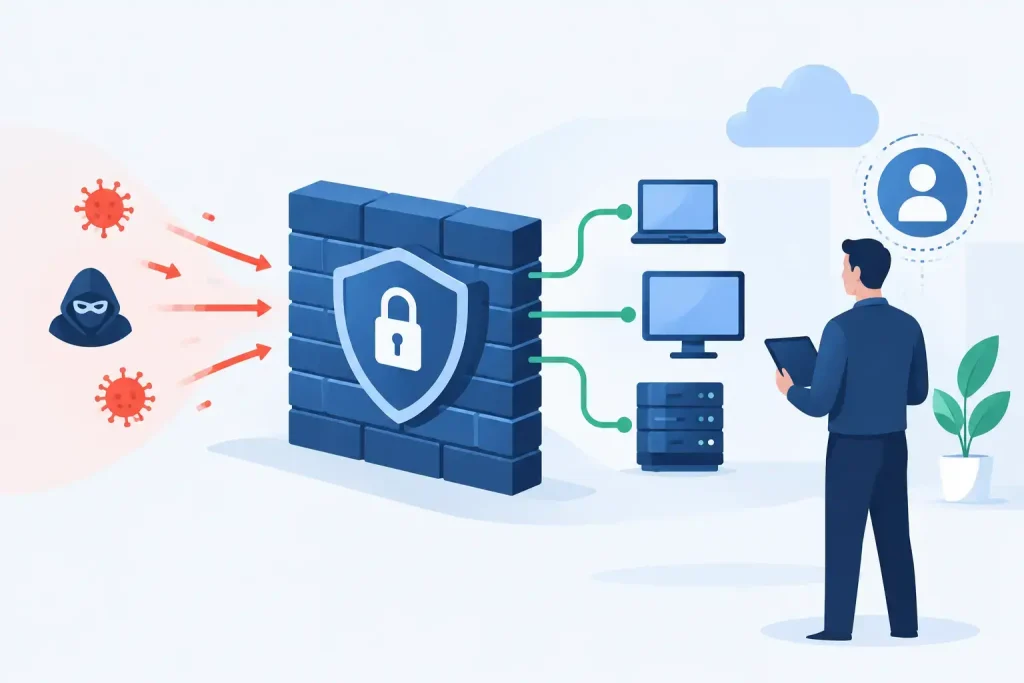
A next-generation firewall can inspect traffic, block known threats, control applications, enforce network segmentation, support secure remote access, and generate detailed logs. Those capabilities matter. But a firewall only protects the business when it is properly designed, configured, monitored, updated, and reviewed over time.
Too often, organizations buy a capable appliance during a project, configure it for the immediate need, and then treat it as finished. Rules accumulate. Former vendors retain remote access. Temporary exceptions become permanent. Software updates wait because nobody wants to risk an interruption. Logs exist, but no one is consistently reviewing what they reveal.
That is the gap a managed service is meant to close. The objective is not simply to put another dashboard in front of an internal IT team. It is to establish clear operating responsibility for the security edge of every location.
What a managed firewall should actually include
The term can mean very different things from one provider to another. Some providers lease hardware and call it managed. Others offer alert forwarding with limited response authority. A meaningful managed firewall service combines technology, operational process, and defined ownership.
At a minimum, the service should begin with a documented design. That includes the business locations, Internet circuits, network segments, cloud applications, remote-access requirements, critical systems, and any compliance-driven controls. A firewall policy should reflect how the organization works, not a generic template applied to every site.
Day-to-day management should cover policy administration, operating system and signature updates, configuration backups, health monitoring, log review, and incident response procedures. If a circuit fails or a device becomes unstable, the responsible team should be able to distinguish a carrier problem from a local network issue, then drive the resolution instead of passing the problem between vendors.
The best operating model also includes regular policy review. Network environments change faster than most organizations realize. A new cloud platform, acquisition, location opening, building renovation, vendor integration, or shift in remote-work policy can change the risk profile overnight. Firewall rules need the same discipline applied to financial access, user accounts, and physical keys.
Why ownership matters more than alerts
Security tools generate signals. Ownership determines what happens next.
An alert about unusual outbound traffic may be harmless, or it may indicate a compromised endpoint communicating with a malicious service. It takes context to tell the difference. Is the system a point-of-sale terminal, a medical device, a guest Wi-Fi user, a file server, or a newly deployed cloud backup appliance? Is that traffic expected at this time? Does it violate an approved policy? Who can isolate the device if it does?
A managed provider should have enough visibility into the broader environment to answer those questions quickly. That is especially valuable for organizations juggling separate vendors for Internet service, Wi-Fi, switches, voice, endpoints, and security. When every provider sees only its own piece, incident response slows down. The client becomes the coordinator during the exact moment they need a clear answer.
One team that owns the whole stack can identify whether the problem began with the carrier circuit, firewall, network configuration, endpoint behavior, or application dependency. That does not eliminate every incident. It removes avoidable handoffs and gives leadership one accountable escalation path.
Managed firewall design for multi-site operations
A single office can often tolerate a simpler design than a portfolio of clinics, communities, stores, campuses, or commercial properties. Once multiple locations are involved, consistency becomes a security and operations issue.
Each site may need its own local rules, but the foundation should be standardized. Network segmentation, administrative access, remote connectivity, logging, update schedules, and failover behavior should follow an approved operating model. That makes new locations faster to deploy and makes troubleshooting more reliable when problems occur.
Segmentation deserves particular attention. A guest Wi-Fi network should not have the same path to internal resources as a staff network. Building systems, cameras, payment devices, clinical equipment, voice systems, and corporate workstations often have different risk profiles and availability needs. Separating these environments limits how far an issue can spread and makes policies easier to understand.
Redundancy also needs to be considered as part of firewall design. A security appliance cannot preserve uptime if there is only one Internet circuit and no alternate connection path. Depending on the site, the right approach may include a secondary carrier, wireless backup, high-availability firewall hardware, or an approved failover plan. The answer depends on the operational cost of downtime, not on a generic checklist.
The trade-offs to discuss before outsourcing firewall operations
Managed service does not mean giving up control. It means deciding which tasks require internal approval and which can be handled under predefined authority. That distinction should be documented before an incident occurs.
For example, an internal IT leader may want approval for new application access or permanent policy changes, while authorizing the managed team to block a confirmed malicious destination immediately. Emergency change authority should be clear, especially for organizations operating outside normal business hours.
There is also a cost trade-off. A lower monthly price may exclude after-hours response, hardware replacement coordination, policy reviews, or active monitoring. Those gaps can be acceptable for a low-risk site with limited hours. They are rarely acceptable for environments that support residents, patients, financial transactions, public-facing services, or distributed operations.
Standardization can introduce another trade-off. A consistent security baseline makes support and auditing easier, but it should not force every site into the same configuration. A retail branch, senior living community, medical office, and corporate headquarters can share common controls while still requiring different segments, access policies, and continuity priorities.
Questions to ask a managed firewall provider
Before selecting a provider, decision-makers should look beyond the brand of firewall hardware. The operating model matters just as much as the appliance.
Ask who monitors the environment, what happens after a high-severity alert, and whether the provider has authority to contain a verified threat. Ask how configuration changes are requested, documented, and reviewed. Clarify response commitments for a security event, a hardware failure, and a connectivity issue.
Also ask whether the provider manages the related network components and carrier relationships. A firewall issue can look like an Internet outage, and an Internet outage can look like a firewall failure. Providers that can see both sides of the handoff can resolve problems faster and provide a more accurate explanation of what happened.
Finally, ask for a clear inventory of what is included: device lifecycle management, licensing, software updates, backups, reporting, policy review, remote access, cellular failover, and after-hours support. Predictable billing is useful, but only if the scope is equally predictable.
Security that supports operations
The right managed firewall program should reduce risk without becoming a barrier to the business. Users should be able to work. Locations should stay connected. New services should be introduced through a controlled process instead of a workaround. When something fails, the organization should know who is responsible for restoring service and protecting the environment.
That is the practical value of managed security: fewer blind spots, fewer vendor handoffs, and a clear owner when the network edge becomes the point of pressure. Before the next expansion, audit, or security event forces the question, define who is watching the firewall and who has the authority to act.