
A branch cannot pause transactions because the Wi-Fi is unstable. A loan office cannot wait until tomorrow for access to core applications. When a circuit fails, a security alert fires, or a teller workstation goes down, outsourced IT for financial institutions is tested in the moment – not in the sales presentation.
For banks, credit unions, mortgage lenders, wealth management firms, and other financial organizations, managed IT is not simply a way to reduce internal workload. It is a decision about operational control. The right partner gives leadership one accountable team for technology performance across users, locations, connectivity, security, voice, and recovery. The wrong arrangement adds another vendor to an already fragmented support model.
Why Financial Institutions Need More Than Basic IT Support
Financial institutions operate under pressures that most office environments do not share. Customer trust depends on secure, reliable access to accounts and services. Regulatory expectations demand disciplined controls. Branch and office locations often rely on a mix of aging systems, cloud applications, third-party platforms, ATMs or specialty devices, and carrier connections that must work together.
That complexity creates a common failure pattern: an internet provider points to the firewall, the firewall vendor points to the application, the application provider points to the local network, and the local team is left coordinating the outage. During that time, employees cannot serve customers and leaders have no clear owner for resolution.
A managed provider should reduce that friction. It should not merely answer help desk tickets. It should understand how the technology environment supports daily operations, identify weak points before they become incidents, and take ownership when multiple systems intersect.
What Outsourced IT for Financial Institutions Should Cover
The scope of outsourced IT for financial institutions should reflect the environment being supported. A single-site advisory firm has different needs than a multi-branch credit union, but both need clear accountability and a security-first operating model.
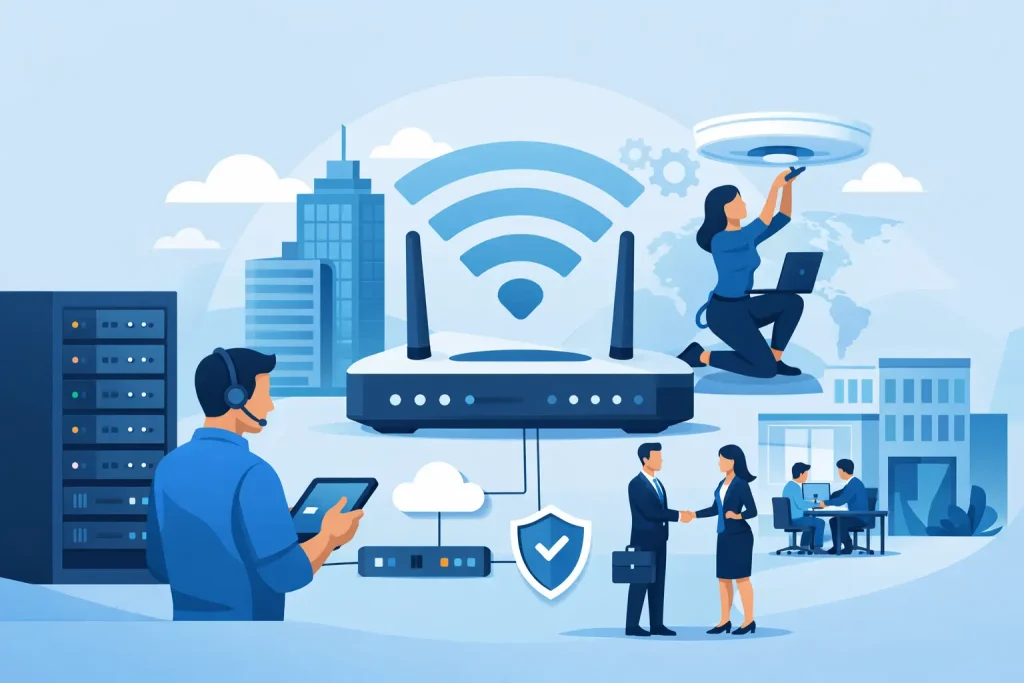
At a practical level, the provider should manage endpoints, user support, network equipment, wireless access, patching, backups, identity controls, and cybersecurity monitoring. For organizations with multiple sites, the service model should also include WAN design, carrier coordination, circuit monitoring, failover planning, and consistent standards across locations.
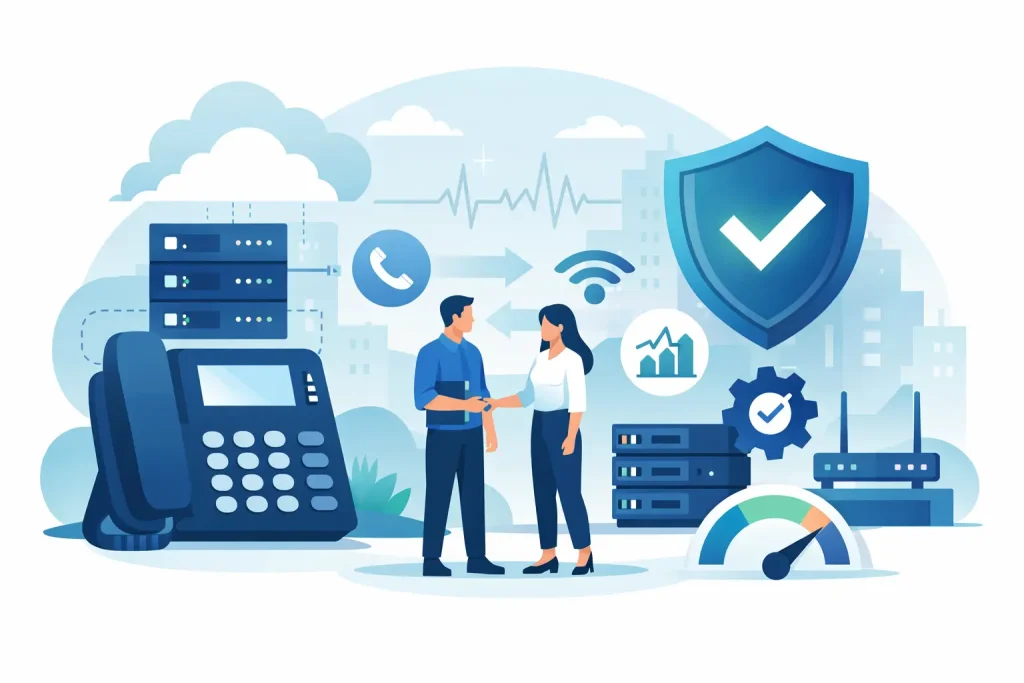
Voice systems belong in the conversation as well. If customers cannot reach a branch, lending desk, or service team during an outage, the business impact is immediate. A technology partner that can support both IT and communications removes a major source of vendor handoffs.
The goal is not to outsource every technology decision blindly. Internal leaders should retain ownership of risk appetite, budget priorities, and business strategy. The managed provider should bring engineering depth, operational discipline, and the capacity to execute those decisions consistently.
Security Must Be Operational, Not Decorative
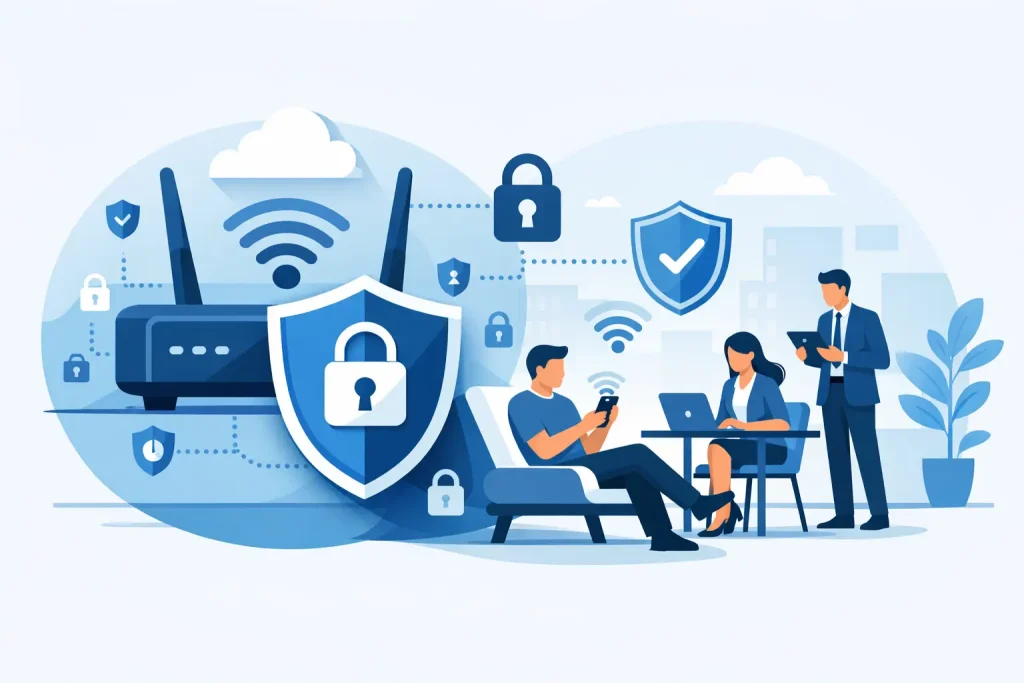
Financial data is a high-value target. That makes a checkbox approach to cybersecurity inadequate. A security program must be tied to the way employees actually work, the systems they use, and the locations they depend on.
Effective managed security starts with fundamentals: managed endpoint protection, multi-factor authentication, least-privilege access, timely patching, secure email controls, encrypted backups, and documented incident response procedures. It also requires visibility. Leadership should be able to understand what is being monitored, which risks are being addressed, and how quickly critical events are escalated.
There is no single product that makes a financial institution secure. Layered controls matter because failures occur in layers too. A phishing email, an unpatched device, a weak password, and a poorly segmented network can each create exposure. The provider’s role is to build defenses that work together and to keep those defenses maintained over time.
Connectivity Is Part of the IT Service
Many managed IT engagements fail because connectivity is treated as someone else’s responsibility. That may be tolerable for a small office with one internet connection. It is not acceptable for a branch network, call center, or operations team that needs dependable access to cloud platforms and customer systems.
A serious provider assesses available carriers, designs primary and backup connectivity, monitors circuit performance, and coordinates escalation when service degrades. Carrier-neutral sourcing is particularly valuable because it allows the solution to fit the location rather than forcing every branch into the same service option.
Redundancy also needs to be designed around real business requirements. A secondary connection is useful only if failover is configured, tested, and capable of supporting the services that must remain available. Some locations may need full operational continuity. Others may only need enough capacity for essential transactions and communications. The right answer depends on the role of the site, acceptable downtime, and budget.
How to Evaluate an Outsourced IT Partner
The most useful question is not, “What is your monthly per-user price?” It is, “Who owns the outcome when several technology layers fail at once?” Financial institutions should look for a provider that can answer that question directly.
Start with operational accountability. Ask how incidents are triaged, who communicates during a major outage, and whether the provider coordinates with carriers, software vendors, and hardware manufacturers. A support desk that logs tickets is not the same as an engineering team that drives resolution.
Next, examine the provider’s approach to standards. Strong managed environments are documented and repeatable. Devices are inventoried, configurations are backed up, access is reviewed, and network diagrams are maintained. Without documentation, every change and every incident becomes slower, riskier, and more dependent on individual memory.
Response commitments also deserve scrutiny. Financial organizations need more than a general promise of good service. They need defined escalation paths, measurable response expectations, and direct access to people who can make technical decisions. Real engineers, not a 1-800 black hole, make a meaningful difference when a branch is offline.
Finally, assess whether the provider can support the full stack. If IT support, internet circuits, voice, cybersecurity, and disaster recovery are all separate contracts, internal staff will still be the integration layer. A single-source model is not automatically better, but it is valuable when the provider has proven competence across those services and accepts responsibility for how they work together.
Build the Relationship Around Risk and Continuity
A productive managed IT relationship begins with an assessment, not a generic package. The provider should document the current environment, identify critical systems, review security gaps, evaluate connectivity dependencies, and establish a prioritized improvement plan.
That plan should distinguish between urgent remediation and strategic modernization. Replacing everything at once is rarely necessary or financially responsible. Some risks require immediate action, such as unsupported firewalls, unprotected administrator accounts, unreliable backups, or a single internet connection at a critical site. Other improvements can be phased around budget cycles, lease expirations, branch openings, or planned system changes.
Disaster recovery needs the same discipline. Backups alone are not a recovery strategy. Leaders should know where data is stored, how frequently it is protected, how long restoration will take, and which systems come back first. Recovery testing is essential because an untested backup is only an assumption.
For multi-location institutions, consistency is a force multiplier. Standardized firewalls, wireless configurations, user policies, and monitoring tools make it easier to support branches, onboard employees, and investigate incidents. Standardization does not mean ignoring local needs. It means avoiding unnecessary variation that increases risk and support cost.
A Better Operating Model for Technology
The value of outsourcing is not that an outside company replaces every internal technology function. Its value is that leadership gains a disciplined operating model: clear ownership, documented standards, proactive maintenance, and a team prepared to respond when operations are at risk.
Southeast Networks approaches this model by bringing managed IT, connectivity, voice, cybersecurity, and disaster recovery into one accountable relationship. That structure matters most when an issue crosses vendor boundaries and the organization needs action rather than finger-pointing.
The best time to evaluate your technology support model is before a branch outage, security incident, or failed recovery test forces the decision. Start by identifying the systems your customers and employees cannot afford to lose, then make sure one capable team is responsible for keeping them available.