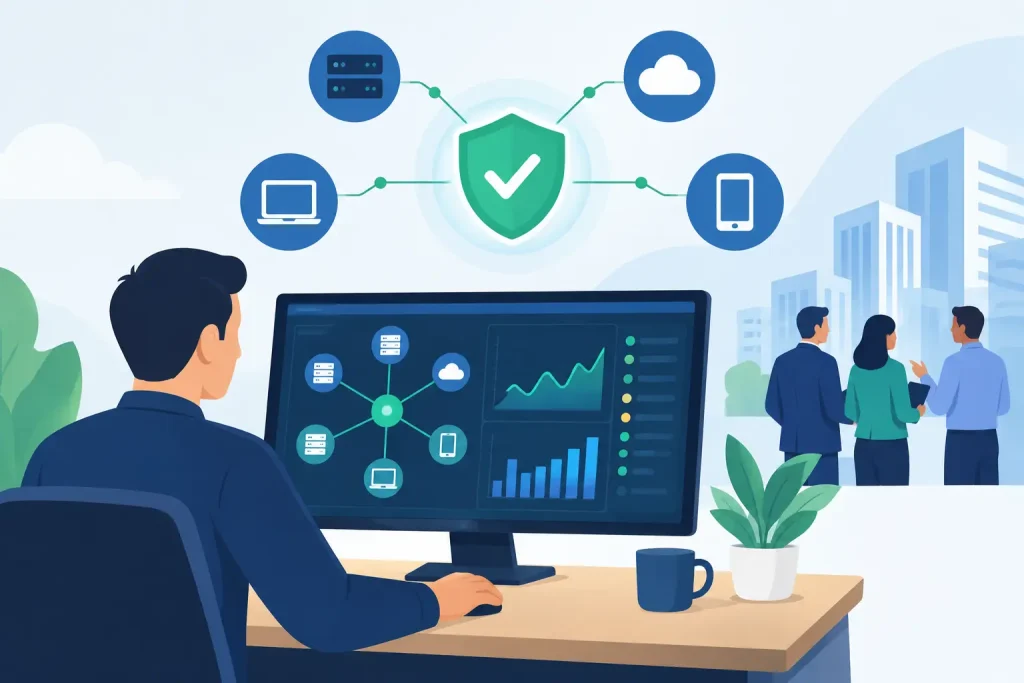

An outage at one location can quickly become an operations problem everywhere else. A failed circuit disrupts cloud applications, a security alert waits for review, and staff lose access to the systems they need to serve residents, patients, customers, or students. The co managed it vs msp decision is not simply about who answers help desk tickets. It determines who owns the response, how technology decisions get made, and whether gaps between internal teams, carriers, and vendors are addressed before they create downtime.
For organizations with growing complexity, the right model is the one that gives leadership clear accountability without giving up the expertise or control the business still needs.
Co Managed IT vs MSP: The Core Difference
A managed service provider, or MSP, takes primary responsibility for the day-to-day management of an organization’s technology environment. Depending on the agreement, that can include user support, endpoint management, network monitoring, patching, backup oversight, cybersecurity, vendor coordination, and strategic planning. The internal team may be small or nonexistent. The provider becomes the operating IT function.
Co-managed IT is a shared operating model. An internal IT team remains in place and continues to own selected responsibilities, while the provider adds capacity, specialized expertise, tools, and coverage. A co-managed partner might manage 24/7 monitoring, security operations, escalation support, network projects, documentation, or multi-site standards while the internal team stays close to users, business applications, and leadership priorities.
Neither model is inherently better. The real question is whether your organization needs an IT department, an extension of one, or a single team that can take ownership of the full technology stack.
The distinction matters because shared responsibility can be highly effective only when it is specific. If internal IT assumes the provider is handling a security alert, while the provider assumes it is an internal responsibility, the model has failed before anyone begins troubleshooting. Clear ownership, escalation paths, response expectations, and decision rights are the foundation of co-managed success.
What a Full-Service MSP Is Built to Solve
A full-service MSP is often the practical choice for organizations that do not have enough internal IT staff to cover daily support, infrastructure maintenance, security, and planning. This is common in multi-site retail, senior living, private education, commercial property, and professional services environments where technology is business-critical but building a complete internal IT department is not the best use of capital.
The value is not just lower headcount pressure. A capable MSP provides a documented operating model: standardized endpoints, monitored networks, managed backups, security controls, help desk coverage, lifecycle planning, and a defined process for incidents and changes. Leadership has a single accountable partner for the systems that keep operations moving.
That single-source ownership becomes more valuable when IT intersects with connectivity and voice. A user cannot work effectively if the application is healthy but the circuit is unstable, Wi-Fi coverage is inconsistent, or a voice platform is misconfigured. In a fragmented vendor environment, internal staff can spend hours moving between an application vendor, internet carrier, phone provider, and IT support company. A full-service model should reduce that friction by coordinating the entire incident and owning its resolution.
An MSP model does require trust and discipline. The provider needs enough visibility and authority to manage the environment properly. Organizations that retain informal exceptions, purchase technology outside the agreed process, or keep critical credentials undocumented create risk for themselves and the provider. Full ownership works best when standards are agreed upon and followed.
Where Co-Managed IT Creates More Value
Co-managed IT is usually the stronger fit when an organization already has capable internal IT leadership but needs more coverage, deeper specialization, or greater execution capacity. A two-person internal team, for example, may understand the organization’s clinical systems, property platforms, workflows, and users extremely well. What it may not have is 24/7 monitoring, dedicated security operations expertise, network engineering depth, or the time to manage a major infrastructure refresh across several sites.
In that scenario, co-managed IT protects the internal team from becoming a bottleneck. Routine administration and first-line requests can remain internal if that is preferred, while the provider supplies a service desk after hours, handles complex escalations, manages endpoint tooling, or operates the security and backup platforms. The internal team gains leverage without losing its role as a trusted business partner.
Co-management is also useful during periods of change. An acquisition, new facility rollout, cloud migration, compliance initiative, or network redesign can overwhelm an otherwise effective IT department. A provider can supply project engineers and operational support without requiring the organization to hire permanent staff for temporary demand.
The trade-off is coordination. Co-managed environments need more governance than fully outsourced ones. Both parties need access to accurate documentation, a shared ticketing process, a tested escalation matrix, and regular discussions about recurring issues, pending changes, and business priorities. Without those controls, co-managed support can turn into two teams working around each other instead of one operating model.
Compare the Models by Operational Need
Internal expertise and available capacity
If your internal team is primarily reactive, overloaded with support requests, or unable to take vacations without creating risk, a full MSP model may be the cleaner answer. It establishes broader coverage and moves operational accountability to a partner built to deliver it.
If your internal team is strategic and knowledgeable but stretched thin, co-managed IT can preserve that institutional expertise while adding engineers, tools, and operating discipline. The provider should complement the team rather than duplicate it.
Accountability during an incident
This is where many buying decisions become clear. With a full MSP, the provider should lead the incident from triage through vendor coordination and resolution. Your operations team needs updates and a clear recovery path, not a list of numbers to call.
With co-managed IT, define who leads based on the incident type. Internal IT may own a line-of-business application issue, while the provider owns network degradation, endpoint failures, backup recovery, or cybersecurity response. For issues that cross domains, establish one incident commander. Shared support should never mean shared ambiguity.
Security and compliance exposure
Organizations handling protected health information, financial data, student records, or sensitive resident information need controls that are consistently deployed and monitored. A full MSP can centralize security policy, vulnerability remediation, identity controls, endpoint protection, logging, and response procedures.
A co-managed provider can perform the same functions, but the division of labor must be documented. If the internal team manages identities while the provider manages endpoints, both parties need to know who approves access, reviews privileged accounts, and acts on alerts. Security gaps often develop at handoffs, not within a single tool.
Multi-site infrastructure and connectivity
For multi-location organizations, IT support cannot be separated from network and carrier performance. New sites need circuit planning, failover design, Wi-Fi standards, voice readiness, firewall configuration, and ongoing visibility. When different vendors own each layer, the burden of coordination typically falls back on internal staff.
Whether you choose co-managed IT or a full MSP, look for a partner that can take responsibility beyond the desktop. Carrier-neutral connectivity sourcing, managed networking, voice, cybersecurity, and disaster recovery should operate as connected parts of one business continuity plan. One team that owns the whole stack is easier to manage than a collection of vendors protecting narrow boundaries.
Budget predictability and growth plans
A full MSP model generally provides the clearest recurring cost structure because a larger portion of IT operations is included in a defined monthly service. It can make planning easier for finance leaders, particularly when the organization has no intention of expanding internal IT headcount.
Co-managed IT can be more flexible, but it requires careful scope design. Decide which services are recurring, which projects are billable, what after-hours coverage includes, and how new locations or employees affect pricing. The goal is not the lowest monthly number. It is a model that prevents surprise costs from unplanned downtime, rushed projects, or emergency vendor calls.
How to Choose Between Co-Managed IT and an MSP
Start with an honest operating assessment, not a preference for outsourcing or control. Review your internal team’s workload, technical depth, coverage hours, documentation quality, security responsibilities, vendor burden, and ability to support the next phase of growth. Then identify the consequences of failure. A brief interruption at a corporate office is different from an outage that affects patient care, resident safety, point-of-sale transactions, building access, or a remote learning environment.
A full MSP is usually appropriate when leadership wants a partner to run daily IT operations and provide a clear point of accountability. Co-managed IT is usually appropriate when internal IT delivers meaningful business value but needs resources it cannot efficiently build in-house.
Before selecting either model, ask how the provider handles a circuit outage, ransomware alert, failed backup, office move, and after-hours escalation. Ask who communicates with carriers and third-party vendors. Ask what is documented, what is monitored, and what service levels are measured. Real engineers, not a 1-800 black hole, should be available when operations are on the line.
The best support model should make technology less visible to the business because it is working as intended. Choose the arrangement that gives your team clear ownership, tested recovery paths, and the capacity to keep moving when the unexpected happens.