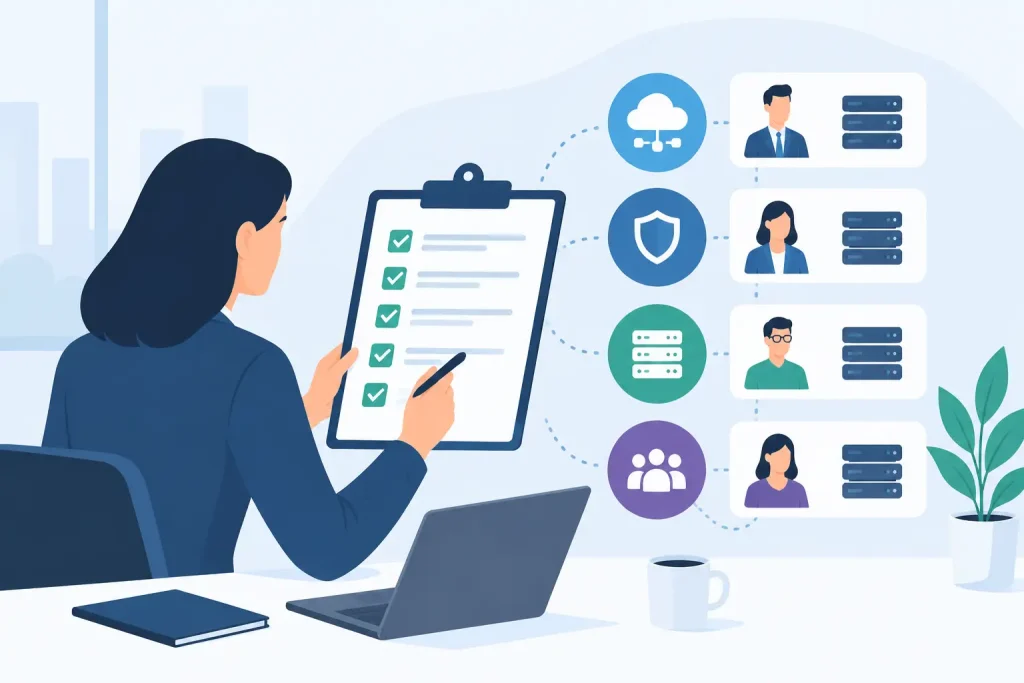

A storm takes out your primary circuit at 9:12 a.m. Your phones go down, cloud apps start timing out, and your team is suddenly improvising around a problem that should have had a playbook. That is exactly where a business continuity disaster recovery plan proves its value. It is not a document built for audits or board decks. It is an operating plan for keeping the business running when technology, facilities, carriers, or people are under pressure.
For organizations with multiple locations, regulated data, customer-facing systems, or thin staffing, the risk is not just downtime. It is confusion. Teams lose time deciding who owns the incident, which systems matter most, what gets restored first, and when to fail over versus wait. A strong plan removes that uncertainty.
What a business continuity disaster recovery plan actually covers
Many companies still treat business continuity and disaster recovery as interchangeable terms. They are related, but they solve different problems.
Business continuity is about maintaining critical operations during disruption. That includes communications, alternate workflows, staffing contingencies, vendor coordination, and the minimum service level required to keep serving customers, residents, patients, students, or tenants. Disaster recovery is narrower. It focuses on restoring systems, data, connectivity, and infrastructure after a disruptive event.
Put together, a business continuity disaster recovery plan answers two practical questions. First, how does the organization continue operating when normal conditions fail? Second, how does technology recover in the right order, within the right timeframe, with the least business impact?
That distinction matters because technology outages rarely stay inside the server room. A failed firewall can interrupt payment processing. A carrier outage can isolate a clinic. A ransomware event can stall admissions, billing, access control, and customer communications at the same time. If the plan only covers backups, it is incomplete.
Why most plans fail when tested
The failure is usually not lack of effort. It is bad scope.
Some plans are too technical. They document systems in detail but ignore operational reality. Others are too general. They say the business will communicate, relocate, or restore, but they do not define who does what, in what order, with what dependencies. In both cases, teams end up making high-pressure decisions with partial information.
A second common issue is vendor fragmentation. One provider manages circuits, another handles voice, another hosts backups, another supports endpoints, and someone internal is expected to coordinate the whole event. During a real incident, that model breaks down fast. Everyone owns a piece, but no one owns the outcome.
Plans also age badly. New locations open. Platforms change. Teams turn over. Compliance requirements shift. If the plan is not tied to the actual production environment and reviewed on a schedule, it becomes shelfware.
Start with business impact, not technology inventory
The right place to begin is not a list of servers. It is a business impact analysis.
Which functions must stay available for the organization to keep operating? In healthcare, that may include clinical communications, EHR access, medication workflows, and life safety systems. In senior living, it may include nurse call, internet access for operations, VoIP, and access control. In retail, it may be payment processing, WAN connectivity, inventory systems, and store communications. In private education, continuity may center on campus connectivity, learning platforms, phones, and building systems.
Once those priorities are clear, you can define recovery objectives that reflect business reality. Recovery Time Objective, or RTO, sets how quickly a system must return. Recovery Point Objective, or RPO, defines how much data loss is acceptable. There is no universal right answer. Some applications can tolerate hours. Others cannot tolerate minutes. The trade-off is cost, complexity, and operational risk.
This is where experienced planning matters. If every system is labeled mission-critical, nothing is prioritized. If too many systems are pushed to lower priority, the business finds out the hard way that the assumptions were wrong.
The core components of an effective plan
A usable plan is specific, current, and aligned to real operating conditions.
The first component is governance. Someone must have authority to declare an incident, activate continuity procedures, and escalate across business units and vendors. Roles should be named, with backups assigned. If the primary contact is unavailable, the plan cannot stall.
The second is dependency mapping. Critical services do not fail in isolation. Voice depends on internet and power. Cloud access depends on identity systems and local network performance. Security tools may depend on logging platforms and administrative access. If you do not map dependencies, recovery sequencing becomes guesswork.
The third is communications. Teams need predefined internal and external messaging paths for staff, customers, leadership, and third parties. During an incident, silence creates as much damage as the outage itself.
The fourth is technical recovery. That includes backup strategy, failover design, carrier diversity, endpoint recovery, authentication continuity, and application restoration order. It should also address alternate site requirements where relevant. For some organizations, remote work is the fallback. For others, operations need a physical location with connectivity, phones, and secured access.
The fifth is documentation discipline. Configuration records, carrier account details, circuit IDs, license information, support contacts, and escalation paths should be accurate and quickly accessible. In a real outage, missing account information costs time you do not have.
How to build a business continuity disaster recovery plan that works
A strong plan is usually built in phases because that is how risk is best reduced.
Phase 1: Identify critical processes and tolerances
Start by interviewing operations, IT, finance, facilities, and executive stakeholders. The goal is to establish what absolutely must continue, what can pause, and what the downstream impact looks like by hour, day, and week. This turns continuity planning into a business decision, not just an IT project.
Phase 2: Assess the current environment
Review circuits, firewalls, wireless, voice platforms, cloud dependencies, endpoint management, backup coverage, identity controls, and third-party services. This step often reveals blind spots, especially in multi-site organizations where one location has redundancy and another does not.
Phase 3: Design recovery paths
For each critical function, define the primary and fallback methods of operation. That may mean secondary internet, SD-WAN failover, cloud voice rerouting, immutable backups, alternate login methods, hot spare hardware, or manual workarounds. The best design depends on risk tolerance and budget. A hospital-grade recovery posture is not the same as a back-office administrative site.
Phase 4: Assign ownership and escalation
Every action in the plan should have an owner. Not a department, a person or role. If a carrier must be escalated, who makes that call? If failover must be approved, who authorizes it? If end users need direction, who sends it? Precision matters.
Phase 5: Test the plan under pressure
Tabletop exercises are useful, but they are only the beginning. If possible, test specific failover scenarios, backup restores, alternate routing, and communications workflows. The gap between what is documented and what actually works tends to show up quickly.
The role of infrastructure design
No plan can compensate for weak infrastructure.
If your sites rely on a single carrier, flat network design, aging firewalls, inconsistent backups, or unsupported voice systems, recovery options will be limited no matter how well the document is written. Resilience is partly procedural, but it is also architectural.
That is why many organizations tie continuity planning to broader managed infrastructure oversight. One team that understands the network, internet services, voice environment, security controls, and endpoint estate can make better decisions about dependencies and recovery paths. It also reduces the coordination problem that appears during high-impact events.
For that reason, Southeast Networks approaches continuity as an operational system, not a paperwork exercise. The plan has to match the way the environment is actually built and supported.
Common trade-offs leaders should expect
There are always trade-offs, and pretending otherwise leads to bad decisions.
Faster recovery usually costs more. Greater redundancy can increase monthly spend. More aggressive backup intervals can add complexity. Highly available designs reduce some risks while introducing more moving parts to manage. The right answer depends on the cost of downtime, compliance exposure, reputation risk, and the internal capacity to support the environment.
There is also a practical trade-off between standardization and flexibility. Standardized infrastructure across locations makes recovery easier, but some sites have unique constraints. The plan should account for those exceptions without turning every location into its own special case.
A plan is only real if it stays current
A business continuity disaster recovery plan should change as the business changes. New applications, office moves, acquisitions, staffing changes, security upgrades, and carrier transitions all affect recovery assumptions.
At minimum, review the plan annually and after any major technology or facility change. Update contact trees, validate dependencies, confirm backup scope, and rerun tests against the most likely disruption scenarios. Cyber events, utility failures, ISP outages, and localized facility incidents usually deserve more attention than rare edge cases because they happen far more often.
The goal is not perfection. It is controlled response.
When the next outage hits, your team should not be debating priorities, chasing vendors, or discovering that the backup excluded a critical workload. They should know what matters, who owns each action, and how the business keeps moving while systems recover. That is what makes continuity planning worth the investment.