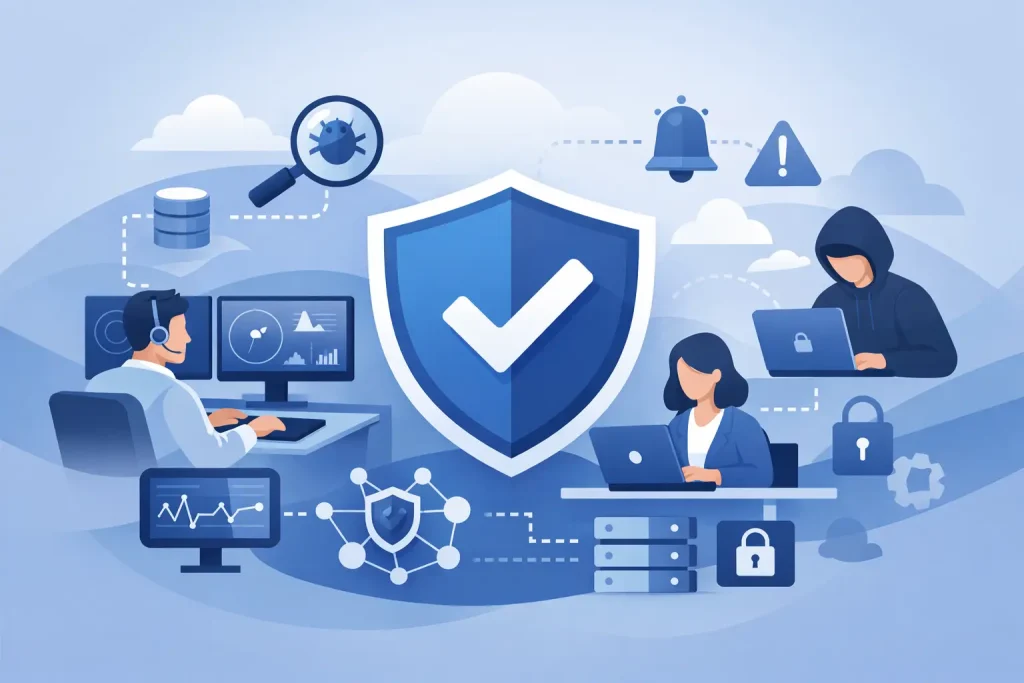

At 8:12 a.m., a clinic does not care whether the problem sits in the firewall, the ISP circuit, the wireless network, the endpoint, or the EHR workstation image. It cares that registration is backed up, staff are improvising, and patients are waiting. That is why managed IT support for healthcare has to be designed around accountability, not just tickets. In a care environment, every layer matters, and the handoff between vendors is often where delays, blame, and operational risk pile up.
Healthcare organizations have a more demanding technology burden than many industries. They run critical applications across exam rooms, nurse stations, imaging areas, administrative offices, and increasingly remote and mobile workflows. They also deal with compliance pressure, staffing constraints, aging infrastructure, cybersecurity threats, and the simple reality that downtime affects care delivery fast. A provider can tolerate very little ambiguity when systems go down.
What managed IT support for healthcare should actually cover
A lot of providers hear the term and picture a help desk plus basic device maintenance. That is too narrow. Effective managed IT support for healthcare should cover the full operating environment: endpoint support, network management, Wi-Fi performance, cybersecurity controls, backup and disaster recovery, voice systems, Internet connectivity, vendor coordination, and escalation paths that make sense when a site is under pressure.
This matters because healthcare outages are rarely isolated. A slow check-in process may start with a workstation complaint, but the root cause may be a congested network, failing switch, unstable circuit, or misconfigured wireless access point. If one provider handles desktops, another handles telecom, another handles security, and someone else sold the circuit, staff lose time just figuring out who owns the issue. In practice, that fragmentation becomes its own failure point.
The stronger model is one team that owns the whole stack, or at minimum owns the response across it. That does not mean every environment looks identical. A multi-site specialty group has different requirements than a skilled nursing operator or regional outpatient network. But the operating principle is the same: if technology affects patient flow, compliance, or revenue cycle, support needs to be integrated.
Why healthcare environments break under generic IT support
Generic managed services can look cost-effective on paper. The problem is that healthcare creates conditions that expose shallow support models quickly. Workflows are time-sensitive. Devices move between users and departments. Internet outages can affect cloud applications, phones, remote specialists, and connected devices at the same time. Security events are not hypothetical. And every interruption creates a chain reaction across scheduling, documentation, billing, and patient experience.
A provider that serves law firms, small retailers, and medical groups with the same support design may miss what healthcare operations require. Response times are part of it, but so is context. If a nursing station loses connectivity, the issue is not just technical. It is clinical and operational. If a VoIP outage cuts off inbound patient calls, the risk touches access and revenue, not just phone service.
This is also where vendor sprawl becomes expensive. Many healthcare organizations have separate relationships for IT, phones, cybersecurity tools, copier networks, circuits, and line-of-business software. Each may perform reasonably well within a narrow scope. But when an incident crosses boundaries, no one owns the total outcome. Decision-makers end up managing multiple escalations in real time, which is exactly what they were trying to avoid.
The infrastructure priorities that matter most
Healthcare leaders do not need more technology for its own sake. They need fewer points of failure and clearer control. That starts with stable connectivity. If an organization depends on cloud-hosted EHR, imaging transfer, telehealth, or centralized voice systems, Internet performance is not a utility line item. It is production infrastructure. Redundancy, circuit diversity, failover design, and active monitoring need to be planned, not added after repeated outages.
Next comes the local network. Many healthcare locations struggle with Wi-Fi dead zones, overloaded switches, unmanaged growth in connected devices, and aging cabling or edge hardware. The result is inconsistent application performance that users experience as random slowness. In reality, the environment has outgrown the original design. Managed support should include lifecycle planning and network standards, not just break-fix visits.
Endpoint management is another major factor. Shared devices, clinical workstations, front-desk PCs, and mobile endpoints all need policy control, patching, security tools, and replacement planning. Waiting until devices fail creates unnecessary operational drag. The better approach is standardized deployment, monitored health, and predictable refresh cycles tied to business risk.
Then there is cybersecurity. In healthcare, security cannot be bolted on as a separate project. Identity controls, endpoint protection, email security, backup integrity, vulnerability management, user awareness, and incident response planning all have to work together. The right level of investment depends on the size and complexity of the organization, but underinvesting usually costs more later.
Compliance matters, but operations come first
Healthcare buyers often start the conversation with compliance, and that is reasonable. HIPAA requirements, audit readiness, access controls, and documentation all matter. But compliance by itself does not keep a site running. Plenty of environments can produce policies while still suffering from weak network design, poor visibility, inconsistent support, and recovery plans that have never been tested.
The better view is that compliance should be a result of disciplined operations. When systems are inventoried, access is controlled, logs are reviewed, backups are verified, and change management is documented, compliance becomes easier to support. When those fundamentals are missing, compliance efforts tend to become reactive and fragmented.
This is one area where executive teams should ask tougher questions. Not just whether security tools are installed, but whether anyone is actively managing them. Not just whether backups exist, but whether recovery timelines are realistic for clinical and administrative operations. Not just whether there is a help desk, but whether escalation reaches engineers who can resolve infrastructure problems without bouncing the issue across vendors.
What to look for in a healthcare IT partner
The right provider should bring more than technical coverage. They should bring operational ownership. That means clear service boundaries, real engineering depth, measurable response expectations, and the ability to coordinate carriers, voice, network, security, and end-user support as one managed environment.
Healthcare organizations should also look for maturity in how the provider assesses risk. A strong partner does not simply quote licenses and devices. They evaluate site dependencies, single points of failure, WAN design, wireless performance, backup strategy, support workflows, and the business impact of downtime. They help leadership understand where the environment is exposed and what should be fixed first.
There is a cost trade-off here. Comprehensive managed support is not the cheapest option, especially if an organization has been underinvesting for years. But low monthly fees often hide higher total cost in the form of outages, staff inefficiency, emergency projects, security incidents, and constant vendor management overhead. Healthcare leadership teams usually feel that cost long before it appears in a budget report.
Southeast Networks approaches this the right way: one accountable team across IT, connectivity, voice, cybersecurity, and recovery planning. For healthcare organizations, that model reduces friction where it hurts most – during outages, escalations, and fast-moving operational issues.
Managed IT support for healthcare in multi-site operations
Multi-site healthcare environments face a different order of complexity. A single urgent care site can be disrupted by one circuit failure. A regional operator can be disrupted by inconsistency across ten locations. Different Internet providers, mismatched firewall policies, uneven Wi-Fi coverage, and ad hoc support practices create avoidable instability.
Standardization helps, but only if it is practical. Some sites need higher resiliency because they carry heavier patient volumes or support more critical services. Some legacy locations cannot be rebuilt overnight. That is why the best support model balances standards with site-level reality. The goal is not perfect uniformity. It is controlled variation with known risk and clear support ownership.
For finance and operations leaders, this has another benefit: predictability. When infrastructure, support, and carrier management are consolidated, it becomes easier to forecast costs, compare site performance, and plan upgrades before failures force the issue. That is a much better position than reacting to one-off crises with emergency spend.
Healthcare technology is only getting more distributed, more security-sensitive, and more central to daily operations. The organizations that handle that pressure best are not the ones with the most vendors or the most tools. They are the ones with clear standards, resilient infrastructure, and one team that can answer the phone, find the root cause, and own the fix.